
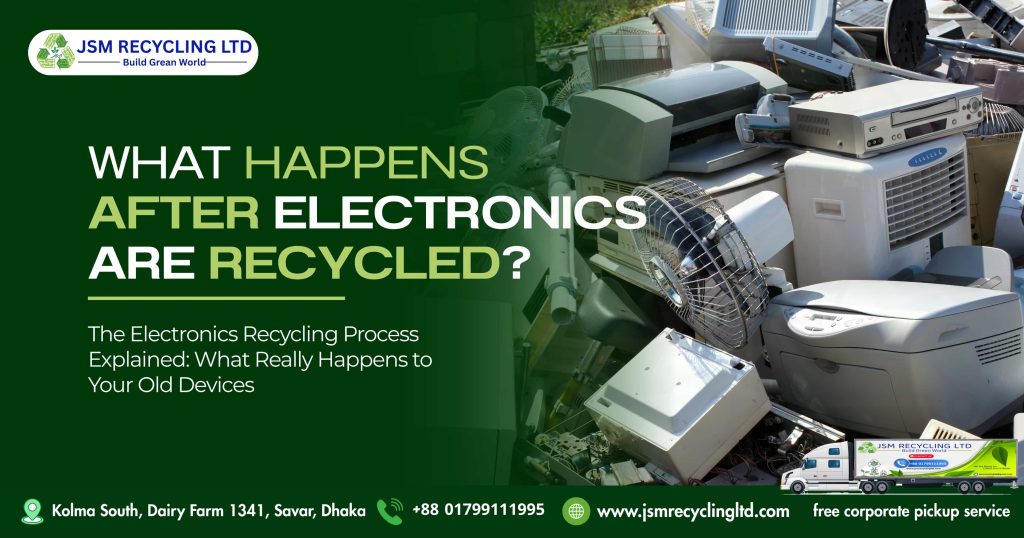
Have you ever wondered what actually happens after you drop off your old laptop or broken phone for recycling? The electronics recycling process is far more complex — and more important — than most people realize. Every year, millions of discarded devices end up in the wrong hands or the wrong places, releasing toxic chemicals, exposing sensitive data, and poisoning the environment. In Bangladesh, this challenge is growing fast.
This article walks you through every stage of the e-waste recycling process — from collection to material recovery — so you understand exactly why responsible recycling matters, and how you can be part of the solution right here in Bangladesh.
What Is the Electronics Recycling Process?
A Simple Definition
The electronics recycling process refers to the systematic collection, sorting, dismantling, and processing of discarded electronic devices — commonly called e-waste — to safely recover usable materials and dispose of hazardous components without harming people or the planet.
It is not just about throwing old devices into a bin. It is a carefully managed, multi-step lifecycle that transforms something potentially toxic into something valuable.
Common Electronics That Go Through This Process
Almost every electronic device you own will eventually need to be recycled. This includes:
- Smartphones, tablets, and laptops
- Desktop computers and monitors
- Televisions and set-top boxes
- Printers, scanners, and photocopiers
- Refrigerators, air conditioners, and other home appliances
- Medical equipment and office electronics
- Batteries and power banks
Each of these devices contains a mix of recoverable materials — and hazardous ones — making proper processing essential.
The Step-by-Step E-Waste Recycling Process
Understanding what happens at each stage helps you appreciate why informal or unregulated recycling is so dangerous. Here is how professional e-waste processing works.
Step 1: Collection and Transportation
The process begins when devices are collected — either from businesses through scheduled corporate pickups or from the public through community drop-off events. Responsible recyclers like JSM Recycling Ltd provide free corporate pickup services, making it easy for offices and organizations to dispose of bulk electronics safely.
Once collected, devices are securely transported to a certified processing facility. Chain-of-custody documentation ensures every item is tracked from the moment it leaves your hands.
Step 2: Sorting and Categorization
At the facility, devices are sorted by type, condition, and material composition. This is a critical step — different device categories require different processing methods. For example, cathode ray tube (CRT) monitors need special handling because they contain lead, while lithium batteries must be isolated to prevent fire risks.
Sorting also helps identify which devices can be refurbished and resold, extending their useful life before they are dismantled.
Step 3: Data Destruction — The Step Most People Miss
Here is something many Bangladeshi businesses and individuals overlook entirely: your old device still holds your data, even after a factory reset.
Before any physical processing begins, certified recyclers perform verified data destruction. This involves overwriting hard drives, degaussing magnetic media, or physically shredding storage components — depending on the sensitivity level required. JSM Recycling Ltd provides government-authorized data destruction services with verifiable certificates, ensuring your confidential information never falls into the wrong hands.
This step protects individuals, but it is absolutely critical for businesses, hospitals, banks, and government institutions that handle sensitive records.
Step 4: Manual Dismantling
Once data is securely destroyed, trained technicians manually disassemble the devices. Components are carefully separated — circuit boards, batteries, screens, cables, plastic casings, and metal frames are all removed and sorted into different streams.
Manual dismantling allows skilled workers to remove hazardous materials carefully, preventing toxic substances like mercury, cadmium, and brominated flame retardants from contaminating the environment during later processing stages.
Step 5: Material Processing and Precious Metals Recovery
This is where e-waste transforms into real value. Circuit boards and electronic components are rich in precious metals — including gold, silver, copper, and palladium. Professional processors use smelting, hydrometallurgy, and pyrometallurgy to extract these metals efficiently.
According to the Global E-Waste Monitor 2024, the raw material value embedded in global e-waste is estimated at over $91 billion USD annually. Yet less than a quarter of that value is actually recovered through formal recycling channels worldwide. The rest is lost — often through informal burning and acid-washing that poisons communities.
Recovered copper and aluminum are sent to metal refineries. Plastics are separated by polymer type and either recycled or safely processed. Glass from screens is recovered for use in new manufacturing.
Step 6: Safe Disposal of Hazardous Residues
Not everything can be recovered. Some residual materials — including certain plastics, contaminated components, and chemical byproducts — must be disposed of through approved hazardous waste channels. A 100% landfill-free operation like JSM Recycling Ltd ensures none of these materials are simply dumped, eliminating one of the most damaging outcomes of informal e-waste handling.
Why Proper E-Waste Recycling Matters
The Human Health Impact
Improper e-waste disposal is a public health crisis. When old electronics are burned in the open or broken apart without protection, toxic substances — including lead, mercury, arsenic, and dioxins — are released into the air, water, and soil. The World Health Organization (WHO) has directly linked informal e-waste processing to respiratory disease, neurological damage, reproductive harm, and increased cancer risk, particularly among workers and children living near unregulated dump sites.
This is not a distant problem. It is happening in communities across Bangladesh right now.
The Environmental and Business Impact
E-waste that ends up in landfills or waterways leaches heavy metals into groundwater. This affects agriculture, fisheries, and drinking water — all critical to Bangladesh’s economy and food security. For businesses, the stakes are equally high: improper disposal of corporate electronics can expose organizations to legal liability and reputational damage.
On the positive side, responsible recycling of electronics significantly reduces the demand for virgin raw material extraction — lowering the environmental footprint of the electronics industry as a whole.
The Hidden Danger: Data Security
This is the insight most Bangladeshi readers do not think about until it is too late. When a company hands over old computers or smartphones to an informal recycler — or simply throws them away — those devices likely still contain:
- Employee records and payroll data
- Client databases and financial records
- Login credentials and banking information
- Confidential communications
A single recovered hard drive sold in a secondhand market can expose years of sensitive corporate data. Certified data destruction is not optional for businesses — it is essential.
The E-Waste Problem in Bangladesh: A Closer Look
How Big Is the Problem?
Bangladesh generates an estimated 400,000 metric tonnes of e-waste annually, according to recent data from the Bangladesh Department of Environment (DoE). With rapid urbanization, rising smartphone penetration, and a growing middle class, this number is increasing every year. Yet the formal recycling infrastructure to handle this volume responsibly remains limited.
What Is Happening Right Now?
Currently, the majority of e-waste in Bangladesh is handled by the informal sector — small workshops and individual collectors who dismantle electronics without any safety equipment, environmental controls, or data security protocols. Devices are often burned to recover copper wire, or acid-washed to extract gold from circuit boards, releasing toxic fumes and contaminating local water sources.
Why Informal Methods Are Failing
Informal recycling might seem economical, but the true costs are staggering:
Factor | Informal Recycling | Certified Recycling (e.g., JSM) |
Worker Safety | No protection | Full PPE and safety protocols |
Data Security | None | Certified destruction + certificate |
Environmental Impact | High — burning and dumping | Zero landfill, zero open burning |
Legal Compliance | None | Government-authorized (DoE) |
Material Recovery | Partial, inefficient | Systematic, maximized |
Corporate Liability | High risk | Fully documented, risk-free |
The gap is clear. Informal methods extract short-term value while creating long-term harm — for people, communities, and businesses alike.
How to Recycle Electronics Responsibly in Bangladesh
Safe Methods and Best Practices
Responsible electronics disposal does not have to be complicated. Here is what you — or your organization — should do:
- Never throw electronics in regular waste bins. This guarantees landfill contamination.
- Never sell to informal scrap dealers without verifying their credentials. You could be exposing your data and your community.
- Choose a government-authorized recycler who provides proper documentation of disposal.
- Request a recycling or data destruction certificate for all corporate electronics.
- Participate in organized community drop-off events if you are disposing of personal devices.
What to Do Before Recycling Your Device
Before handing over any device, take these steps:
- Back up any files or data you want to keep
- Sign out of all accounts (Google, Apple ID, banking apps)
- Remove SIM cards and external memory cards
- Request certified data destruction from your recycler — do not rely on a factory reset alone
Why Choose a Government-Authorized Company
In Bangladesh, the Department of Environment (DoE) authorizes specific companies to legally collect, process, and dispose of e-waste. Choosing a DoE-authorized recycler is not just safer — it protects your organization from potential legal liability under Bangladesh’s evolving environmental compliance framework. For businesses in Bangladesh, working with a certified partner is quickly becoming both a regulatory expectation and a corporate responsibility benchmark.
How JSM Recycling Ltd Is Solving Bangladesh's E-Waste Problem
Responsible Recycling at Every Step
JSM Recycling Ltd has operated for over 8 years as Bangladesh’s leading e-waste recycling company — and every single device processed during that time has been handled with zero landfill disposal. That is not a marketing claim; it is a verified operational standard built into every stage of their recycling process. From collection to material recovery, every step follows international best practices adapted to Bangladesh’s local context.
Government Authorized and Data Destruction Certified
JSM Recycling Ltd is officially authorized by the Bangladesh Department of Environment (DoE), making it one of the very few legally compliant e-waste processors in the country. Their certified data destruction service ensures that sensitive information from corporate devices is completely and verifiably eliminated — with documentation you can audit. Whether you are a multinational corporation, a local bank, a hospital, or a government agency, JSM provides the legal cover and peace of mind your organization needs.
Free Corporate Pickup and Community Drop-Off Events
JSM Recycling Ltd has hosted over 130 community events across Bangladesh — reaching individuals, schools, businesses, and local governments to make responsible e-waste disposal accessible to everyone. Their free corporate pickup service removes every barrier for businesses looking to dispose of large volumes of electronics properly. And their growing network of community drop-off events means that responsible recycling is no longer just for large organizations — it is available to every Bangladeshi household.
Your Old Device Deserves a Better End
The electronics recycling process is a powerful chain of steps that — when done right — protects people, recovers valuable materials, and keeps toxic waste out of Bangladesh’s soil and water. But it only works when electronics end up in the right hands.
Whether you are a business managing hundreds of old devices or an individual with a single broken phone, the choice you make about disposal has real consequences. The electronics recycling process exists to make that choice easy — and responsible.
Contact JSM Recycling Ltd today — Bangladesh’s only 100% landfill-free, government-authorized e-waste recycling company. Schedule your free corporate pickup or find your nearest community drop-off event at jsmrecyclingltd.com.
Frequently Asked Questions (FAQ)
Q1: What is the electronics recycling process?
The electronics recycling process is the step-by-step collection, sorting, dismantling, data destruction, and material recovery of discarded electronic devices. It ensures that toxic components are handled safely and that valuable materials like copper, gold, and aluminum are recovered for reuse — rather than dumped in landfills or burned.
Q2: Is it dangerous to throw old electronics in regular bins?
Yes, very. Electronic devices contain harmful materials such as lead, mercury, cadmium, and brominated flame retardants. When disposed of in landfills, these substances can seep into the soil and contaminate groundwater.When burned informally, they release toxic fumes linked by the WHO to neurological damage, respiratory disease, and cancer — particularly dangerous for children and nearby communities.
Q3: Is there a law in Bangladesh about e-waste disposal?
Yes. Bangladesh’s Department of Environment (DoE) has established regulations governing e-waste collection, transportation, and processing. Businesses that improperly dispose of electronic waste may face legal penalties under Bangladesh’s Environment Conservation Act. Using a DoE-authorized recycler like JSM Recycling Ltd ensures full legal compliance.
Q4: How can I recycle my old electronics in Bangladesh?
You have two easy options with JSM Recycling Ltd: (1) If you are a business or institution, request a free corporate pickup at jsmrecyclingltd.com/services/corporate-pickup. (2) If you are an individual, find your nearest community drop-off event at jsmrecyclingltd.com/services/community-events. Both options are free, safe, and fully certified.
Q5: Does JSM Recycling Ltd provide a recycling or data destruction certificate?
Yes. JSM Recycling Ltd provides verified data destruction certificates for all corporate clients. This certificate confirms that your organization’s data has been irreversibly destroyed according to certified standards — giving you the legal documentation you need for compliance and audit purposes.