
Why Your Business Needs a Certified Data Destruction Service
If you are a business owner or an IT manager in Bangladesh, a certified data destruction service is no longer a luxury; it is a critical security requirement. Every time you retire an old laptop, server, or hard drive, you are potentially leaving behind a digital footprint that could cost your company millions in reputation and legal fees. Simply deleting files or formatting drives is not enough to protect your sensitive data from falling into the wrong hands.
In today’s fast-paced digital landscape, electronic waste is growing rapidly. Many organizations unknowingly dispose of their old hardware through informal channels, where data can be easily recovered using basic recovery software. This article explores how to properly handle your end-of-life IT assets, why professional verification matters, and how you can stay compliant with the latest environmental and security standards in Bangladesh.
Understanding Professional Data Destruction
What is data destruction?
At its core, data destruction is the process of permanently destroying the data stored on tapes, hard disks, and other electronic media so that it can never be recovered, accessed, or reconstructed. It goes far beyond the “Delete” or “Format” buttons found in your operating system.
How it works
Professional destruction involves specialized techniques that physically or digitally alter the storage media. This might include high-level degaussing (using magnets to scramble the magnetic fields), software-based wiping that meets international security standards, or physical shredding of the drive platters.
Common Methods of Data Destruction
1. Degaussing
Degaussing is a fast, effective way to destroy data on magnetic media like hard drives and backup tapes. It uses a high-intensity magnetic field to randomize the data on the platters, rendering the drive completely unusable.
2. Software Wiping (Overwriting)
This method involves using specialized software to overwrite the entire drive with patterns of random data. While effective for drives that you intend to reuse, it is often slower than physical destruction and must be verified by a trusted provider.
3. Physical Shredding
This is considered the gold standard for data security. The device is placed into an industrial-grade shredder that breaks the storage media into tiny, unrecoverable fragments.
4. Incineration
Used for high-security environments, incineration involves burning the storage media at extremely high temperatures. This ensures that even the microscopic traces of information are destroyed through thermal decomposition.
Why Secure Disposal Matters for Every Business
Protecting your human capital
When you dispose of hardware improperly, you aren’t just risking company secrets. You are also risking the personal data of your employees—such as NID numbers, bank details, and home addresses. A breach can cause direct, personal harm to the people who keep your business running.
The environmental and business impact
In Bangladesh, e-waste is a rising environmental crisis. When you use a data destruction company, you ensure that the remaining metal, plastic, and glass components are recycled responsibly rather than being dumped in a landfill. This strengthens your CSR (Corporate Social Responsibility) profile and ensures compliance with local environmental regulations.
The hidden danger: The "Recovery" trap
Most people believe that once a file is moved to the “Trash” and emptied, it is gone. However, forensic software can recover these files in minutes. Even after a factory reset, hackers often have the tools to pull sensitive financial reports or client lists from “discarded” equipment. This is the hidden risk that leads to identity theft and industrial espionage.
The Reality of E-Waste in Bangladesh
The scale of the problem
Bangladesh generates over 400,000 metric tons of e-waste annually, according to reports from the Department of Environment (DoE). With the rapid digitization of our banking, healthcare, and retail sectors, the volume of discarded hard drives and servers is skyrocketing.
What is happening right now?
Currently, a massive portion of this e-waste ends up in the informal recycling sector. In places like Dholaikhal or other unorganized recycling hubs, workers often manually dismantle devices. While this may seem like recycling, it ignores the critical need for data security, leaving data-heavy components vulnerable to theft.
Why informal methods are failing
Informal recycling centers lack the technology to perform certified data destruction. They also lack the environmental controls to handle toxic materials like lead, cadmium, and mercury. By bypassing certified services, businesses are contributing to both a security nightmare and an environmental disaster.
Solutions and Best Practices for Businesses
Safe methods for internal handling
Before you even hand your devices over to a service provider, maintain an internal asset log. Record the serial numbers of all drives and identify which ones contain sensitive information versus which ones are general use.
Preparing for secure disposal
- Inventory: Audit all your IT assets.
- Separation: Segregate drives that contain sensitive company data.
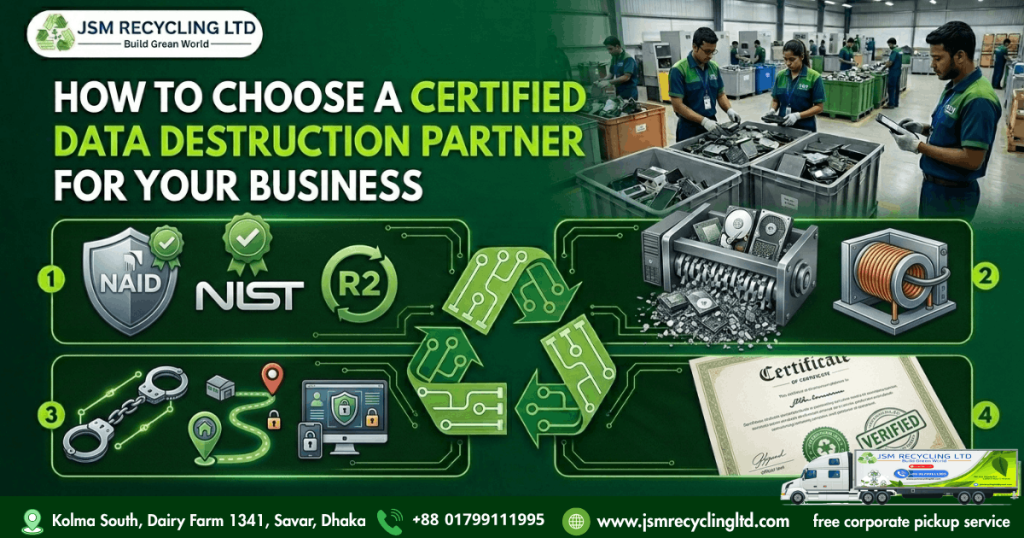
- Chain of Custody: Always ensure you receive a document tracking the device from your office to the point of destruction.
Verification: Never accept a verbal confirmation; demand a Certificate of Destruction
Why choose a government-authorized company?
Choosing a government-authorized company ensures that the provider is held to strict legal and environmental standards. It guarantees that your hardware will not end up in a landfill and that the data destruction process is audited for compliance.
Comparison: Safe vs. Unsafe Disposal
Feature | Informal/Unsafe Disposal | JSM Recycling (Certified) |
Data Security | High risk of data recovery | Guaranteed permanent destruction |
Environmental | Toxic dumping in landfills | 100% landfill-free recycling |
Legal | Non-compliant / Risk of liability | DoE authorized & certified |
Documentation | None | Provided Certificate of Destruction |
How JSM Recycling Ltd is Solving Bangladesh's E-Waste Problem
JSM Recycling Ltd has spent over 8 years setting the gold standard for e-waste management in Bangladesh. We understand that your business needs more than just a pickup service—you need peace of mind.
Responsible Recycling
We operate with a 100% landfill-free policy. We believe that technology should not come at the cost of our environment. Every component is processed according to international environmental standards, ensuring hazardous materials are kept out of our soil and water.
Government Authorized & Data Destruction Certified
We are a government-authorized e-waste recycling company, recognized by the Department of Environment (DoE) in Bangladesh. When you partner with us, you receive a verifiable Certificate of Destruction, ensuring your company meets all legal requirements for data privacy and corporate governance.
Free Corporate Pickup & Community Drop-Off Events
Logistics should never be a barrier to security. We offer free corporate pickup services to make the process seamless for your IT team. Additionally, we have hosted over 130+ community events across Bangladesh, raising awareness about the importance of proper e-waste disposal and providing accessible drop-off points for the public.
Securing your company’s future starts with how you dispose of its past. Using a certified data destruction service is the only way to guarantee that your sensitive business data stays private while keeping Bangladesh’s environment clean. Don’t leave your reputation to chance by relying on informal recycling methods.
Contact JSM Recycling Ltd today — Bangladesh’s only 100% landfill-free, government-authorized e-waste recycling company. Schedule your free corporate pickup or find your nearest community drop-off event at jsmrecyclingltd.com.
Frequently Asked Questions (FAQ)
Q: Why isn’t factory resetting my hard drive enough?
A: A factory reset often only removes the file index, not the actual data. Forensic recovery tools can easily retrieve data from “reset” drives, making physical destruction or professional wiping necessary.
Q: Does JSM Recycling provide proof of destruction?
A: Yes. We provide a formal Certificate of Destruction for every batch of assets we process, giving you an audit trail for your compliance needs.
Q: Is there a cost for corporate data destruction?
A: We offer competitive rates and free corporate pickup services. We encourage you to reach out via our website for a custom quote based on your volume of assets.
Q: Can you handle bulk server disposal?
A: Absolutely. We have the infrastructure to manage large-scale data center decommissioning, including the secure transport and destruction of enterprise-grade server drives.
Q: Are your methods environmentally friendly?
A: Yes, we are 100% landfill-free. We ensure all parts are either reused or recycled in a way that protects the environment, following strict DoE guidelines.