
E-Waste Management in Dhaka: Why Most Businesses Are Getting It Wrong
Most Dhaka businesses treat e-waste management as an afterthought — a one-time call to a scrap dealer when old computers pile up in a storeroom. A real corporate e-waste management strategy is a planned system: regular audits, certified data destruction, and a government-authorized recycling partner. Without one, businesses risk data leaks, DoE non-compliance, and environmental harm. JSM Recycling Ltd offers Bangladesh’s only 100% landfill-free, government-authorized alternative, with free corporate pickup across Dhaka.
A corporate e-waste management strategy is no longer optional for businesses in Dhaka — it is the difference between staying compliant and quietly breaking the law. Walk into almost any office in Gulshan, Motijheel, or Uttara and you will find a storeroom full of dead laptops, cracked monitors, and tangled cables that nobody quite knows what to do with.
Most companies hand this pile to the cheapest scrap buyer they can find, without a second thought about the data still sitting on those hard drives or where the toxic parts end up. This guide breaks down exactly why that habit is risky, and what a real e-waste management strategy looks like for a business operating in Bangladesh today.
What Is a Corporate E-Waste Management Strategy?
A corporate e-waste management strategy is a written plan for how a business collects, stores, securely wipes, and recycles its old electronics through certified partners instead of informal scrap dealers. It covers data destruction, environmental compliance, and staff responsibility — turning e-waste disposal from a random, reactive event into a repeatable, auditable process.
A Simple Definition
E-waste is any device with a plug or a battery that has reached the end of its useful life. For a typical Dhaka office, that means laptops, desktop towers, monitors, servers, hard drives, printers, and old UPS units — anything sitting unused because it is broken, outdated, or replaced.
Why Dhaka Businesses Need One Now
Corporate device counts are growing fast as companies digitize, and refresh cycles for laptops and phones keep getting shorter. At the same time, Department of Environment (DoE) rules on hazardous waste are tightening, and a single leaked client database from an unwiped hard drive can do more damage to a brand than months of marketing can repair.
Types of E-Waste Every Dhaka Office Produces
Before you can manage e-waste, you need to know what actually counts as e-waste inside your business. It usually falls into four categories:
- IT and computer equipment — laptops, desktops, monitors, servers, and hard drives
- Networking and telecom gear — routers, switches, modems, and office phone systems
- Batteries and power equipment — UPS units, power banks, and lithium-ion batteries
- Office electronics and appliances — printers, scanners, projectors, and air conditioners
Why Corporate E-Waste Management Matters
The Health Impact on Workers and Communities
When e-waste is dismantled informally — often by hand, and sometimes by children — workers are exposed to lead, mercury, and cadmium released from circuit boards and batteries. These substances build up in the body over time and are linked to nerve damage and respiratory illness in communities near informal scrapyards.
The Business and Environmental Cost
Unmanaged e-waste is a business liability, not just an environmental one. Devices dumped or burned informally pollute local soil and water, and businesses that cannot show where their electronics went risk fines and reputational damage if regulators or clients ever ask.
The Hidden Danger: Data Security
Here is what most Dhaka businesses do not realize: deleting files from a laptop does not destroy the data. It is still recoverable with basic software. When old devices are handed to a scrap dealer without certified data destruction, client contracts, financial records, and passwords can walk straight out the door on a hard drive nobody thought twice about.
E-Waste in Dhaka: The Local Reality
How Big Is the Problem in Bangladesh?
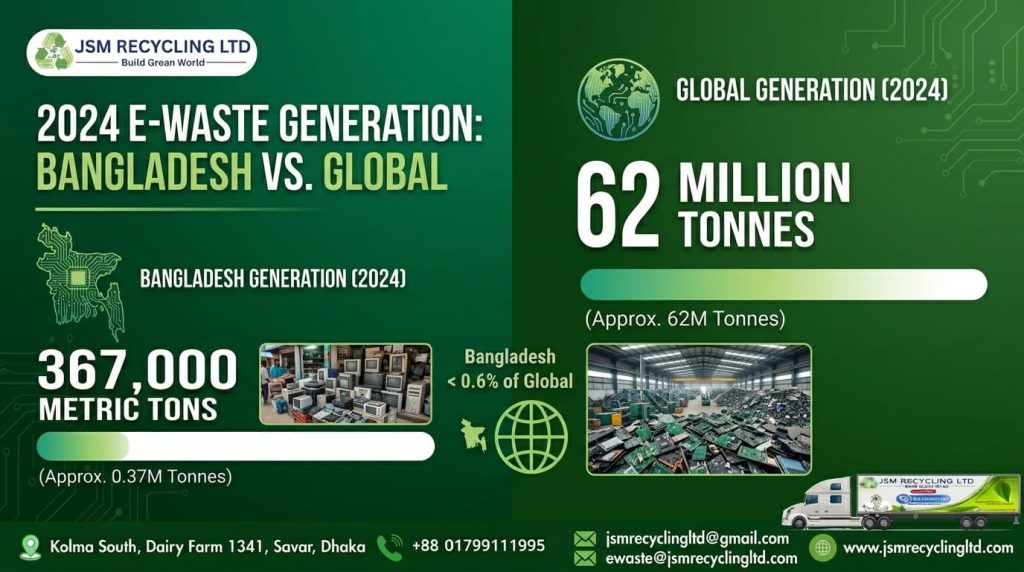
Bangladesh generated close to 367,000 metric tons of e-waste in 2024, equal to about 2.2 kg for every person in the country — Cleaner Waste Systems journal, 2025. That sits inside a much larger global picture: the world generated 62 million tonnes of e-waste in 2022, and only 22.3% of it was properly collected and recycled — Global E-waste Monitor 2024, UNITAR/ITU.
What's Happening Right Now in Dhaka
As Dhaka’s corporate and IT sectors expand, the number of laptops, servers, and phones reaching end-of-life every year keeps climbing. Most of this flow still ends up with informal scrap collectors rather than certified recyclers, simply because businesses have never been shown a formal alternative.
Why Informal Recycling Methods Are Failing Businesses
Informal scrapyards do not wipe data, do not hold DoE authorization, and cannot provide a documented chain of custody. For a business, that means no proof of compliance if an audit or a client questions how sensitive equipment was disposed of — and no way to confirm devices were not simply burned or dumped.
How to Build the Right Corporate E-Waste Management Strategy
A working strategy does not need to be complicated. It needs six clear steps, followed every time:
- Do an e-waste audit — count and log every end-of-life device across your offices.
- Wipe or physically destroy data-bearing devices through certified data destruction.
- Choose a DoE-authorized, landfill-free recycling partner.
- Get a signed destruction or recycling certificate for every batch collected.
- Schedule regular pickups instead of waiting for a storeroom to overflow.
- Train staff on exactly where old devices should go — not into a desk drawer.
Why Choose a Government-Authorized Company
A government-authorized recycler gives you a paper trail that protects your business legally, and it guarantees the environmental claims are real rather than a scrap dealer’s promise. Below is how the options actually compare:
Disposal Method | Data Security | Environmental Impact | Legal Compliance |
100% landfill-free, materials recovered | DoE-authorized, fully documented | ||
Local scrap dealer / kabadiwala | No data wiping — drives resold as-is | Often dismantled or burned informally | No compliance record, no certificate |
Storeroom storage (“deal with it later”) | Data stays on the device, risk grows over time | No immediate impact, but liability builds up | Not compliant — risk remains unaddressed |
How JSM Recycling Ltd Is Solving Dhaka's E-Waste Problem
Responsible, 100% Landfill-Free Recycling
For more than 8 years, JSM Recycling Ltd has kept every device it collects out of landfills, processing electronics through certified, environmentally sound channels instead.
Government Authorized & Data Destruction Certified
JSM Recycling is authorized by the Department of Environment (DoE) and issues verified data destruction certificates for every device collected — the exact documentation your compliance team needs on file.
Free Corporate Pickup & Community Drop-Off Events
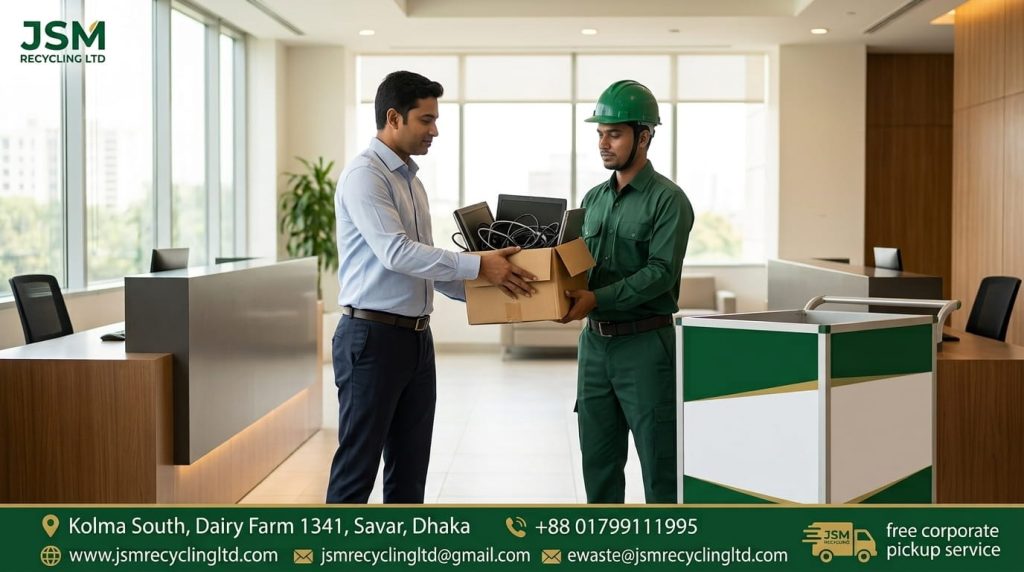
JSM Recycling has run more than 130 community e-waste events across Bangladesh, and offers free scheduled pickup for corporate clients so old electronics never have to sit in a storeroom waiting for someone to deal with them.
Get Your E-Waste Management Strategy Right
Most businesses in Dhaka are not failing at e-waste management on purpose — they simply never built a strategy in the first place. A real corporate e-waste management strategy means auditing your devices, destroying data properly, and working with a certified, landfill-free partner instead of the nearest scrap buyer. Get that right, and you protect your data, your compliance record, and the environment in one move.
Contact JSM Recycling Ltd today — Bangladesh’s only 100% landfill-free, government-authorized e-waste recycling company. Schedule your free corporate pickup or find your nearest community drop-off event at jsmrecyclingltd.com.
Frequently Asked Questions
Q: What is corporate e-waste management?
Corporate e-waste management is the process a business uses to collect, securely wipe, and recycle its old electronics through certified partners instead of throwing them away or selling them to informal scrap dealers.
Q: Is it dangerous to throw away old computers with a scrap dealer?
Yes. Informal scrap dealers rarely wipe data, so sensitive company information can be recovered from the hard drive. They also may burn or dump hazardous parts, which pollutes soil and water and can expose workers to toxic metals.
Q: Is e-waste recycling required by law in Bangladesh?
Bangladesh’s Department of Environment (DoE) regulates hazardous and electronic waste disposal, and businesses are expected to dispose of electronics responsibly. Using a DoE-authorized recycler gives you documented proof of compliance if it is ever questioned.
Q: How can a business recycle e-waste in Dhaka?
A business can schedule a free corporate pickup with a government-authorized recycler like JSM Recycling Ltd, which collects old devices directly from the office and issues a certificate confirming proper, landfill-free disposal.
Q: Does JSM Recycling provide a certificate for e-waste disposal?
Yes. JSM Recycling Ltd issues a verified data destruction and recycling certificate for every batch of devices it collects, giving businesses documented proof for their compliance records.