
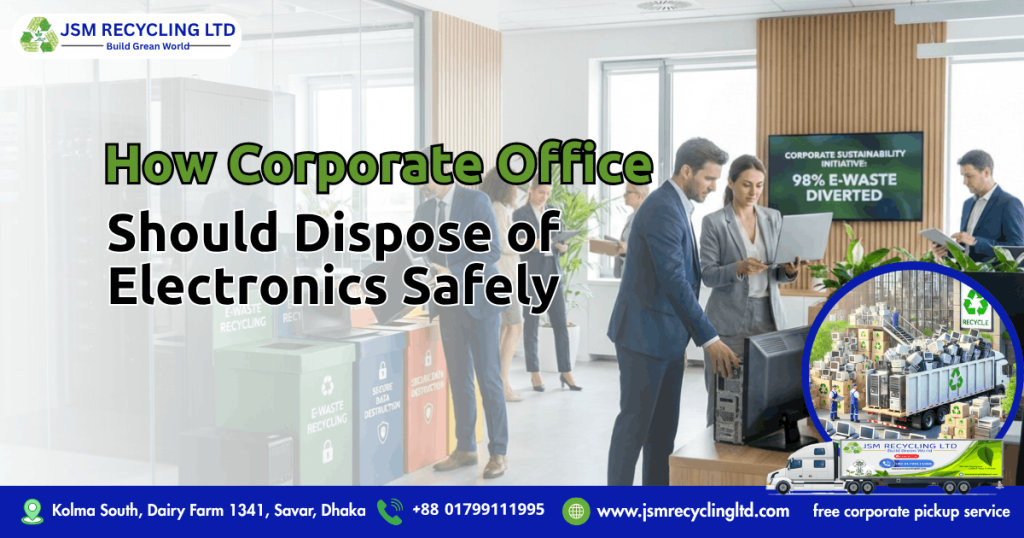
Corporate electronics disposal is no longer optional for businesses in Bangladesh — it is a legal, ethical, and security responsibility that every office must take seriously. Whether you are upgrading 20 laptops or clearing out an entire IT room, how you dispose of those old devices matters more than most managers realize.
Many companies still throw old computers, phones, and printers into general waste bins. Others hand them off to informal scrap dealers. Both approaches are dangerous — for your data, your employees, your community, and potentially your legal standing.
This guide explains what responsible corporate electronics disposal looks like, why it matters specifically in the Bangladeshi business context, and how your company can take the right steps starting today.
What Is Corporate Electronics Disposal?
A Simple Definition
Corporate electronics disposal — also called IT asset disposal (ITAD) — refers to the process of retiring, recycling, or destroying electronic equipment that a business no longer uses. This includes computers, monitors, servers, printers, mobile phones, networking equipment, and other office technology.
The key word here is process. Responsible disposal is not just throwing things away. It involves data destruction, material recovery, and compliance with environmental regulations — all done in a documented, traceable way.
Common Electronics That Businesses Dispose Of
Most Bangladeshi offices deal with the following types of e-waste:
- Desktop computers and laptops — often still containing sensitive business data
- Servers and data storage devices — high-risk items for data breaches
- Printers, copiers, and scanners — often overlooked, but many store scanned documents internally
- Mobile phones and tablets — company-issued devices with emails, passwords, and customer data
- Networking equipment — routers, switches, modems
- UPS systems and batteries — contain lead and acid that are hazardous if improperly discarded
- Monitors and display screens — contain mercury and lead in older models
If your office has any of these sitting unused in a storeroom, it is time to act.
Types of Corporate Electronics Disposal Methods
1. Certified E-Waste Recycling
This is the gold standard. A certified e-waste recycler like JSM Recycling Ltd collects your devices, safely dismantles them, recovers valuable materials (copper, aluminum, gold traces), and disposes of toxic components without landfilling. We will provide you with a disposal certificate for your reference.
2. IT Asset Remarketing
If your equipment is still functional, some ITAD companies will refurbish and resell it — often donating a portion to schools or NGOs. This helps prolong the lifespan of the device while minimizing waste.
3. Secure Data Destruction Services
For devices that hold sensitive information, data destruction must happen before anything else. This means certified hard drive shredding, degaussing, or software-based data wiping — all verified and documented. JSM Recycling Ltd provides verified data destruction certificates to protect your company legally.
4. Manufacturer Take-Back Programs
Some electronics brands offer take-back or trade-in schemes. These are useful but limited — they typically cover only their own brand and may not provide the compliance documentation businesses need.
Why Corporate Electronics Disposal Matters
The Human Health Impact
Old electronics contain toxic materials including lead, mercury, cadmium, and brominated flame retardants. When devices are broken open informally — as often happens with roadside scrap dealers — these substances are released into the air and soil.
Workers in informal recycling operations, many of whom are women and children, face serious health risks: respiratory disease, neurological damage, and increased cancer risk. According to a WHO report on e-waste and child health, children are especially vulnerable to lead and mercury exposure from improperly handled electronics.
This is not a distant problem. It happens in communities across Bangladesh every day.
The Environmental and Business Impact
Toxic e-waste contaminates groundwater and agricultural soil. Businesses that use informal disposal methods may believe they are saving money, but they are transferring environmental costs onto local communities.
From a business perspective, irresponsible disposal also creates reputational risk. As Bangladesh’s export sector grows and international buyers apply ESG (Environmental, Social, and Governance) scrutiny to their suppliers, companies with poor e-waste management policies may find themselves losing contracts.
Sustainable office practices are fast becoming a business requirement, not just a virtue.
The Hidden Danger: Data Security
Here is something most Bangladeshi business owners do not consider: your old hard drive still contains your data, even after you delete files.
Simply deleting a file does not ensure it is permanently removed. Anyone with basic technical knowledge — and free software available online — can recover deleted files from a discarded hard drive. This means customer records, financial data, employee information, login credentials, and confidential business documents can all be recovered from a device you assumed was empty.
A 2019 study by the National Association for Information Destruction (NAID) found that 40% of secondhand hard drives sold online still contained recoverable personal or corporate data. In a country where digital fraud is rising rapidly, this is a serious risk.
Secure data destruction is not optional. It is essential.
The Corporate E-Waste Problem in Bangladesh
How Big Is the Problem?
Bangladesh is generating e-waste at an accelerating pace. According to the Global E-Waste Monitor 2024, South Asia as a region generates millions of tonnes of e-waste annually, and Bangladesh’s share is growing in step with its expanding corporate and manufacturing sectors.
Dhaka alone, home to thousands of corporate offices, generates significant volumes of IT-related e-waste every year. The rapid digitization of Bangladeshi businesses — accelerated by post-pandemic remote work expansion — means more devices are being purchased, cycled through, and retired than at any previous point in the country’s history.
What Is Happening Right Now?
Most corporate e-waste in Bangladesh currently ends up in one of three places:
- Informal scrap markets in areas like Dholaikhal in Dhaka, where devices are broken down with no safety precautions
- General landfill waste, mixed with regular office trash
- Storerooms, where old equipment sits indefinitely — a problem many offices quietly ignore
The Bangladesh Department of Environment (DoE) has regulations under the Bangladesh Environment Conservation Act that cover hazardous waste, and e-waste increasingly falls under this framework. Companies that improperly dispose of hazardous electronic waste may face legal consequences as enforcement improves.
Why Informal Methods Are Failing Businesses
Handing devices to a local scrap dealer may feel like a practical solution, but it creates serious problems:
- No data destruction guarantee — your confidential data could be accessed by anyone
- No disposal certificate — you cannot prove legal compliance if audited
- No environmental accountability — the toxic materials end up contaminating communities
- Reputational exposure — if a data breach is traced back to a discarded device, the legal and reputational consequences fall on your company
Best Practices for Corporate Electronics Disposal
Safe Methods Your Business Should Follow
Method | Data Secure? | Environmentally Safe? | Certificate Provided? |
Certified ITAD company (JSM Recycling Limited) | ✅ Yes | ✅ Yes | ✅ Yes |
Informal scrap dealer | ❌ No | ❌ No | ❌ No |
General bin disposal | ❌ No | ❌ No | ❌ No |
Manufacturer take-back | ⚠️ Varies | ⚠️ Varies | ⚠️ Varies |
In-house IT wipe only | ⚠️ Partial | ❌ No | ❌ No |
Clearly, working with a certified e-waste recycler is the only approach that covers all three pillars: security, environment, and compliance.
What to Do Before Recycling Your Office Electronics
Before handing any device to a recycler, your IT team should:
- Back up all data you want to retain to secure cloud or local storage
- Log the devices — serial numbers, models, and department ownership
- Remove any SIM cards or memory cards from mobile devices
- Request a chain-of-custody document from the recycler confirming pickup and destruction
- Ask for a data destruction certificate for any device that stored sensitive information
Why Choose a Government-Authorized Recycler
Not all recycling companies operate at the same standard. A government-authorized company like JSM Recycling Ltd has been vetted by the Bangladesh Department of Environment (DoE) and operates under documented environmental standards. This protects your company legally and ensures that your devices are handled responsibly — not re-sold to informal scrap networks.
Choosing a certified partner for your business electronics recycling is the clearest way to demonstrate that your company takes its environmental and data responsibilities seriously.
How JSM Recycling Ltd Is Solving Bangladesh's Corporate E-Waste Problem
Responsible Recycling, 100% Landfill-Free
JSM Recycling Ltd has operated for 8+ years with a clear commitment: not a single gram of collected e-waste goes to landfill. Every device collected from corporate clients is processed through documented, environmentally responsible channels — recovering valuable materials, safely neutralizing hazardous components, and keeping toxic substances out of Bangladesh’s soil and water.
This is not a marketing claim. It is a verified operational standard that sets JSM apart in Bangladesh’s recycling landscape.
Government Authorized & Data Destruction Certified
JSM Recycling Ltd is authorized by the Bangladesh Department of Environment (DoE) — meaning corporate clients who use JSM’s services can demonstrate legal compliance with confidence.
Their secure data destruction service provides certified hard drive shredding and verified data wiping, with official certificates issued to your company after each disposal. This documentation is invaluable if your business is ever audited, or if you need to demonstrate ESG compliance to international partners or clients.
Free Corporate Pickup & Community Drop-Off Events
JSM Recycling Ltd removes the logistical barrier that stops many businesses from acting. Their free corporate pickup service means your team does not need to transport heavy equipment anywhere — JSM comes to your office.
For businesses that prefer drop-off, JSM has conducted 130+ community events across Bangladesh, making responsible disposal accessible to companies of every size, in cities and districts beyond Dhaka. You can find your nearest event or schedule a pickup at jsmrecyclingltd.com/services/community-events.
Your Business Has a Responsibility — and a Simple Solution
Corporate electronics disposal is one of those responsibilities that is easy to postpone — until it becomes a crisis. A data breach from a discarded laptop, a regulatory inspection, or a failed ESG audit can all trace back to poor e-waste management.
The good news is that doing the right thing has never been easier for Bangladeshi businesses. JSM Recycling Ltd offers everything your company needs: government-authorized recycling, certified secure data destruction, free corporate pickup, and full documentation for compliance.
Contact JSM Recycling Ltd today — Bangladesh’s only 100% landfill-free, government-authorized e-waste recycling company. Schedule your free corporate pickup or find your nearest community drop-off event at jsmrecyclingltd.com. Visit the For Businesses page to get started.
Frequently Asked Questions (FAQ)
Q1: What is corporate electronics disposal?
Corporate electronics disposal is the process of safely retiring, recycling, or destroying electronic equipment that a business no longer uses. It includes data destruction, material recovery, and proper handling of toxic components — and should always be documented with a disposal certificate.
Q2: Is it dangerous to throw old office computers in regular trash?
Yes, very. Old computers contain toxic substances like lead, mercury, and cadmium that contaminate soil and water when landfilled. More critically, discarded devices may still contain recoverable business data, creating a serious data breach risk for your company.
Q3: Are there laws in Bangladesh about corporate e-waste disposal?
Yes. The Bangladesh Environment Conservation Act and related regulations cover hazardous waste disposal, under which improperly discarded electronics can create legal liability. The Bangladesh Department of Environment (DoE) is the governing authority. As enforcement strengthens, businesses without documented disposal practices face increasing regulatory risk.
Q4: How can my company recycle old office electronics responsibly in Bangladesh?
Contact a certified, government-authorized e-waste recycler like JSM Recycling Ltd. They offer free corporate pickup, handle all device types, provide secure data destruction, and issue official disposal certificates. Visit jsmrecyclingltd.com/for-businesses to arrange a collection.
Q5: Does JSM Recycling Ltd provide a certificate after disposing of our electronics?
Yes. JSM Recycling Ltd issues verified data destruction certificates and disposal documentation for every corporate collection. This gives your business the legal and compliance record it needs, whether for internal audits, international buyer requirements, or DoE compliance.