
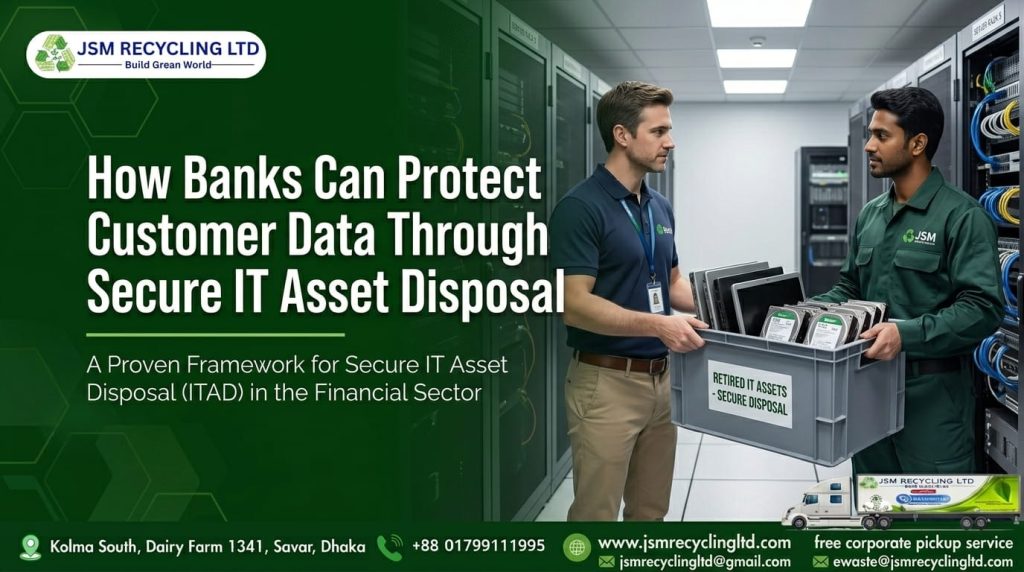
Secure IT asset disposal (ITAD) means permanently destroying customer data on retired bank computers, servers, and ATMs before the hardware is recycled.
Bangladesh Bank’s Guideline on ICT Security (Version 4.0, 2023) requires all data on equipment and storage media to be destroyed or overwritten before sale, disposal, or re-issue.
Banks that skip certified ITAD risk recoverable customer data, regulatory penalties, and reputational damage — global cases like Morgan Stanley’s $163 million SEC settlement show exactly what’s at stake.
Partnering with a DoE-authorized, data-destruction-certified recycler like JSM Recycling Ltd is the safest way to close this gap in Bangladesh.
Every year, your bank retires computers, servers, ATMs, and hard drives — and every one of those devices carries customer data that criminals want. Secure IT asset disposal for banks is the process of destroying that data permanently before old equipment leaves your building, so it can never be recovered by the wrong hands. For a bank, this isn’t just good practice — it’s a direct requirement under Bangladesh Bank’s ICT Security Guideline, and getting it wrong can cost far more than the hardware itself.
If you manage IT, compliance, or operations at a bank, NBFI, or mobile financial service provider in Bangladesh, this guide walks you through exactly what secure IT asset disposal means, why it matters, and how to build a process that protects your customers, your license, and your reputation.
What Is Secure IT Asset Disposal (ITAD) for Banks?
IT asset disposal (ITAD) for banks is the certified process of wiping or physically destroying data on retired hardware, then recycling the equipment through a licensed, environmentally responsible partner. It covers everything from core banking servers to a single branch printer, and always ends with a documented certificate proving the data is unrecoverable.
A Simple Definition
Think of ITAD as the closing chapter of a device’s life inside your bank. Before a laptop, server, or ATM leaves the building for good, its storage media must be shredded, degaussed, or overwritten to an internationally recognized standard — not just factory-reset. Only after that step is the hardware handed to a recycler.
Why Banks Are Different From Other Businesses
A retail shop’s old computer might hold a spreadsheet. A bank’s retired server can hold thousands of customer KYC records, transaction histories, loan documents, and internal credentials. That difference is exactly why Bangladesh Bank places specific ICT security obligations on banks, NBFIs, mobile financial service providers (MFSPs), payment service providers (PSPs), and merchant acquirers — a level of scrutiny most other industries never face.
What Kinds of Bank IT Assets Need Secure Disposal?
Banks generate a wider mix of sensitive e-waste than almost any other sector. Here is what typically needs certified disposal:
- Core Banking & Data Center Equipment — servers, storage arrays, backup tapes, and networking switches holding transaction and account data
- Branch and ATM Hardware — ATMs, cash recyclers, POS terminals, and branch desktops that store cardholder and session data
- Employee and Mobile Banking Devices — staff laptops, tablets, and phones used for internal banking apps, agent banking, or mobile financial services
- Legacy and Backup Storage Media — old hard drives, USB drives, and decommissioned backup systems sitting in a store room after a system upgrade
Why Secure IT Asset Disposal Matters for Banks
Regulatory and Legal Impact
Bangladesh Bank’s Guideline on ICT Security — Version 4.0 (2023) applies to banks, non-bank financial institutions, mobile financial service providers, payment service providers, payment system operators, White Label ATMs, and merchant acquirers. Chapter 5 (Infrastructure Security Management) is explicit: all data on equipment and associated storage media shall be destroyed or overwritten before sale, disposal, or re-issue. Non-compliance exposes your institution to regulatory action.
Environmental and Business Impact
Beyond compliance, careless disposal damages trust. A bank whose old hardware turns up at an informal scrap market — with logos, asset tags, or recoverable data intact — faces a reputational hit that’s hard to undo. Certified, landfill-free recycling also supports the sustainability and ESG reporting most banks are now expected to publish.
The Hidden Danger — Recoverable Data on "Wiped" Drives
Here’s what most IT teams don’t realize: a standard factory reset or file deletion does not erase data — it only hides the index pointing to it. Specialized recovery tools can pull customer records, credentials, and internal documents straight off a “wiped” drive. This isn’t theoretical. Morgan Stanley paid $163 million in additional SEC fines after ITAD mishaps left unencrypted customer data recoverable on decommissioned servers and drives — a case that ITAD experts still cite as the industry’s clearest warning to financial institutions.
Bangladesh's Banking Sector and the E-Waste Data Security Gap
How Big Is the Problem in Bangladesh?
Bangladesh generated approximately 367,000 metric tons of e-waste in 2024, equal to 2.2 kg per person — Cleaner Waste Systems Journal, 2025. IT and office equipment, the exact category banks retire every year, is flagged in that same research as the most sensitive segment because of the confidential data it carries.
What Is Happening Right Now in Bangladesh?
Approximately 97% of e-waste in Bangladesh is processed informally — Transparency International Bangladesh (TIB). Only 3% goes through formal, documented recycling. TIB also found that 88% of consumers are unaware of proper e-waste disposal methods, a gap that easily extends into how retired office and branch hardware gets handled if there’s no internal ITAD policy in place.
Why Informal Methods Are Dangerous for Banks
Informal scrap dealers have no data-wiping standards, no chain-of-custody documentation, and no accountability if a drive resurfaces with customer data intact. For a bank, handing decommissioned hardware to an unregistered buyer — even for a good price — means losing all visibility into where that data ends up. There is no certificate, no audit trail, and no legal protection if something goes wrong.
Here’s how the common disposal routes compare on the things that actually matter for a bank:
Disposal Method | Data Secure? | DoE / BB Compliant? | Recommended for Banks? |
|---|---|---|---|
Yes | Yes | Yes | |
Informal scrap dealer / open market sale | No | No | No |
In-house factory reset only, no physical destruction | Partial | No | No |
Storing retired drives indefinitely in a store room | Partial | No | No |
Donation without certified data wiping | No | No | No |
Burning, crushing, or burial without documentation | No | No | No |
How to Dispose of Bank IT Assets Safely
Safe Methods and Best Practices
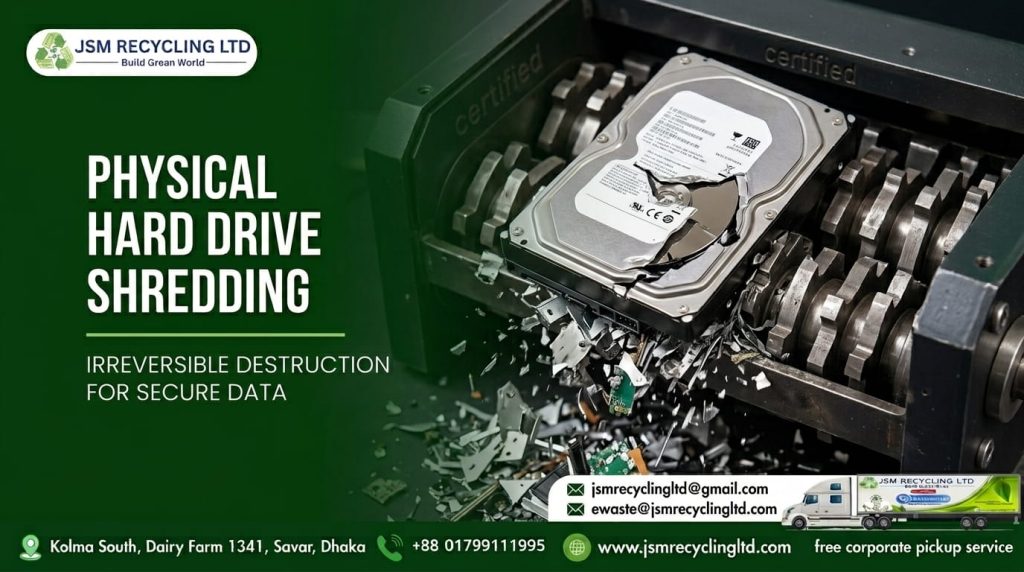
A defensible ITAD process for a bank rests on three pillars: certified data destruction, documented chain of custody, and a government-authorized recycling partner. Physical shredding or degaussing is generally preferred for high-sensitivity storage media such as core banking servers and backup drives.
What to Do Before Recycling or Decommissioning Devices
- Audit your IT assets — list every device being retired, including serial numbers and the data classification it held.
- Back up any needed data — move required files to authorised, encrypted storage before the device leaves service.
- Request certified data destruction — hard drives should be physically shredded or overwritten to a recognized standard (e.g., DoD 5220.22-M), with a Certificate of Data Destruction issued for each batch.
- Choose a registered recycler — confirm your ITAD partner is registered with the Department of Environment (DoE) Bangladesh before handing over a single device.
- Keep the certificates — file every Certificate of Data Destruction and Recycling Certificate; this is your evidence during a Bangladesh Bank ICT audit.
Why Choosing a Government-Authorized Company Matters
Bangladesh Bank’s ICT Security Guideline effectively makes secure disposal a supervisory expectation, not an optional courtesy. A government-authorized, data-destruction-certified recycler is the only type of partner that can give your bank the documentation to prove compliance if you’re ever audited or questioned about a specific device.
How JSM Recycling Ltd Is Solving Bangladesh's Banking Data Security Problem
Responsible Recycling
JSM Recycling Ltd has run a 100% landfill-free operation for over 8 years. Every device your bank retires is processed through a fully documented recycling chain — nothing is burned, buried, or dumped.
Government Authorized & Data Destruction Certified
JSM Recycling Ltd holds formal authorization from the Department of Environment (DoE) Bangladesh and is data destruction certified. For a bank, that means every hard drive, server, and storage device is handled to internationally recognized secure data destruction standards, with a verified Certificate of Data Destruction for your compliance file.
Free Corporate Pickup & Community Drop-Off Events
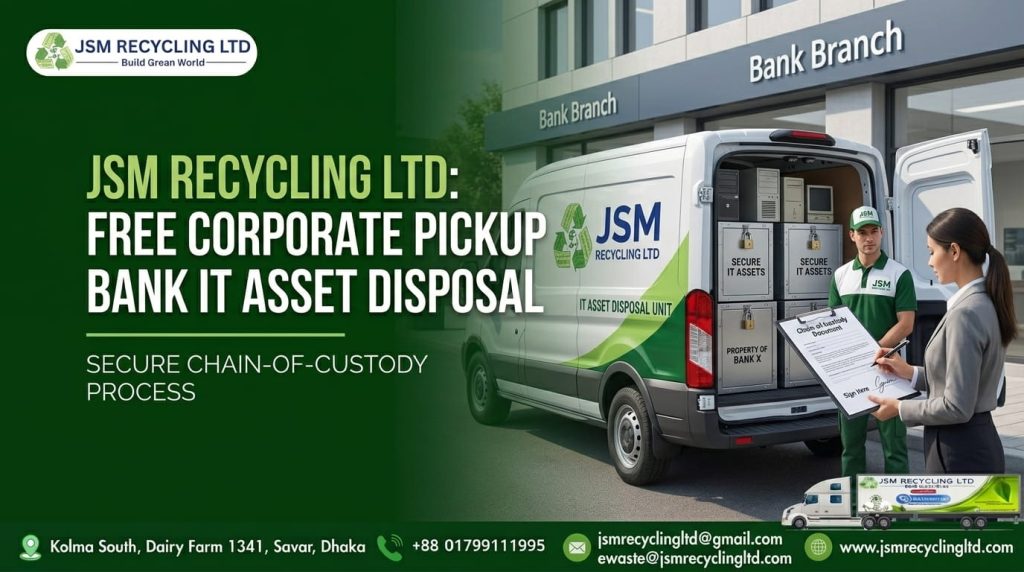
JSM Recycling Ltd offers free corporate pickup for banks and financial institutions anywhere in Bangladesh — schedule a collection and their team handles documentation and destruction end-to-end. Beyond corporate work, JSM has also hosted more than 130 community e-waste events across Bangladesh, extending safe disposal access to employees and the wider public.
Secure IT Asset Disposal Is a Compliance Decision, Not a Housekeeping One
Secure IT asset disposal for banks isn’t a back-office chore — it’s the last line of defense between your customers’ data and a breach that could cost your institution its license, its money, and its reputation. Bangladesh Bank’s ICT Security Guideline already requires it. The only question is whether your bank’s next hardware refresh goes through a certified, documented process, or through a dealer with no accountability.
Contact JSM Recycling Ltd today — Bangladesh’s only 100% landfill-free, government-authorized e-waste recycling company. Schedule your free corporate pickup or find your nearest community drop-off event at jsmrecyclingltd.com.
Frequently Asked Questions (FAQ)
Q1: What is IT asset disposal (ITAD) and why do banks need it?
ITAD is the certified process of destroying data on retired computers, servers, and storage devices before recycling them. Banks need it because their devices hold customer account, transaction, and KYC data that must never be recoverable after disposal.
Q2: What happens if a bank disposes of hardware without wiping the data first?
Deleted files and factory resets don’t erase data — they can often be recovered with common tools. If a device with customer data reaches an informal buyer, it creates a real risk of data theft, regulatory penalties, and reputational damage for the bank.
Q3: Does Bangladesh Bank require secure data destruction for retired equipment?
Yes. Bangladesh Bank’s Guideline on ICT Security, Version 4.0 (2023), states that all data on equipment and associated storage media shall be destroyed or overwritten before sale, disposal, or re-issue. This applies to banks, NBFIs, and other regulated financial service providers.
Q4: How can a bank in Bangladesh dispose of IT equipment safely and legally?
The safest route is a government-authorized recycler such as JSM Recycling Ltd, which offers free corporate pickup, certified data destruction, and full documentation. The bank schedules a collection, and the provider handles destruction, recycling, and certification.
Q5: Does JSM Recycling Ltd provide a certificate after data destruction?
Yes. JSM Recycling Ltd issues a verified Certificate of Data Destruction for eligible devices and a Recycling Certificate for all corporate collections, giving banks documented proof of compliance for internal audits or regulatory review.