
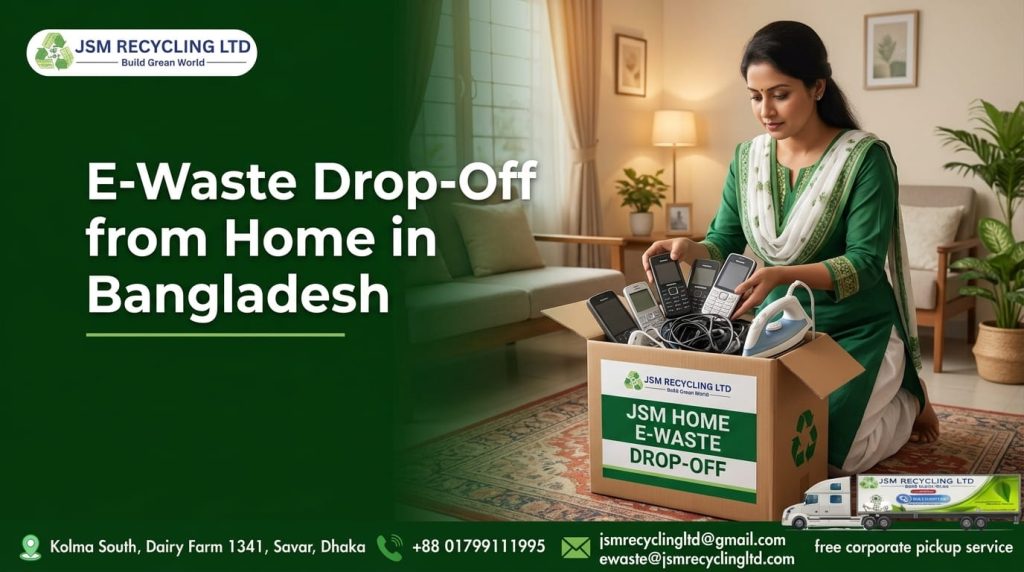
A Complete Guide to E-Waste Drop-Off from Home in Bangladesh
 Quick Answer
E-waste drop-off from home means giving your old phones, chargers, laptops, and appliances to a licensed recycler instead of the trash or a scrap dealer. In Bangladesh, the safest option is a government-authorized program like JSM Recycling Ltd, which holds community drop-off events across the country. This keeps toxic materials out of landfills and your old data out of strangers’ hands.
Every home in Bangladesh has some e-waste hiding somewhere — an old phone in a drawer, a broken charger, a TV nobody watches anymore. E-waste drop-off from home is simply the safe, correct way to get rid of it.
This guide explains what counts as household e-waste, why it matters, and exactly how to drop it off safely near you.
What Is E-Waste Drop-Off from Home?
E-waste drop-off from home is the process of giving your unused electronics to a proper collection point instead of throwing them in household trash. A licensed recycler then handles the sorting, data wiping, and safe processing. It is a small habit with a big impact.
A Simple Definition
If it plugs in, runs on batteries, or has a screen, it’s electronic waste once you stop using it. Dropping it off means handing it to a trusted collector rather than binning it or selling it informally.
Common Household E-Waste Examples
Most families have more of this than they realize. Check your drawers, shelves, and storage boxes.
- Old mobile phones, chargers, and cables
- Laptops, tablets, and computer accessories
- Small kitchen appliances and remote controls
- Batteries, power banks, and old routers
- CFL bulbs and old televisions
Now let’s look at why this matters more than people think.
Why Does Household E-Waste Drop-Off Matter?
Household e-waste drop-off matters because these small items add up fast, and mishandling them harms health, pollutes the environment, and can expose your personal data. Doing it right protects your family and your community.
The Health and Human Impact
Old electronics contain toxic metals such as lead, mercury, and cadmium. When items are broken apart informally, for example by scrap workers without protection, these substances can enter the air, skin, and water supply.
Women are often involved in informal e-waste sorting in Bangladesh, and they face direct exposure to these hazards — Transparency International Bangladesh (TIB), 2025.
The Environmental Impact
When e-waste is dumped instead of recycled, toxic materials can leach into soil and water over time. Since most household e-waste in Bangladesh still ends up this way, even one household switching to safe drop-off makes a real difference.
The Hidden Danger: Your Personal Data
A phone or laptop you plan to give away may still hold photos, messages, banking apps, and saved passwords. Deleting files or doing a factory reset does not always remove them completely.
Secure data destruction means your device’s storage is wiped or destroyed so nobody can recover what was on it. This matters just as much for a family phone as it does for an office computer.
Bangladeshi households generate a large and growing share of the country’s e-waste, and most of it never reaches a proper recycler. Understanding the scale helps explain why safe drop-off habits matter so much right now.
How Big Is the Problem in Bangladesh?
The WEEE Society Bangladesh estimates the country produces 367 million kg of e-waste every year, or about 2.2 kg per person — WEEE Society Bangladesh, via Dhaka Tribune. That’s still far below the global average of 7.8 kg per person, which shows how quickly the number could rise as more households buy electronics — Global E-waste Monitor 2024.
Households are one of the three biggest sources of e-waste in the country, alongside the commercial and informal sectors.
What Is Happening Right Now in Bangladesh?
The Hazardous Waste (e-waste) Management Rules, 2021 set collection targets that rise over time, but the country is still far from meeting them in practice — Transparency International Bangladesh (TIB), 2025. Around 97% of e-waste is handled informally, with only 3% reaching licensed recyclers — TIB, 2025.
TIB also found that 88% of consumers don’t know how to dispose of e-waste properly, and 72% simply keep broken devices at home rather than recycle them — TIB, 2025. About 30 million mobile phones alone turn into e-waste in Bangladesh each year — Bangladesh Mobile Phone Importers’ Association (BMPIA), via Dhaka Tribune.
Why Giving E-Waste to a Scrap Collector Is Risky
It’s common and convenient to hand old electronics to a door-to-door scrap collector, but this usually means the item is dismantled unsafely, and any data on it may never be wiped.
Factor | Door-to-Door Scrap Collector | Licensed Drop-Off Program |
Data safety | No data wiping | Secure data destruction |
Handling method | Manual, unsafe dismantling | Trained, controlled processing |
Legal status | Usually unregistered | Government-authorized (DoE) |
Environmental impact | Dumping or burning | 100% landfill-free processing |
Proof of disposal | None | Drop-off record available |
Knowing this difference is the first step. Next, here’s how to drop off e-waste the right way.
How to Drop Off E-Waste from Home Safely
The safest approach is to gather your old items, remove personal data, and take them to a licensed drop-off event or collection point near you. It takes less time than most people expect.
Safe Steps for Household Drop-Off
- Collect everything at once. Gather old phones, chargers, batteries, and small appliances in one bag or box.
- Back up anything you need. Save important photos or files before handing over a phone or laptop.
- Remove SIM and memory cards. Take these out before drop-off.
- Do a factory reset, but don’t rely on it alone. Ask if the recycler also offers secure data destruction for phones and laptops.
- Find a licensed drop-off point or event. Search for a government-authorized recycler rather than the first scrap shop you find.
- Hand items over directly. Avoid leaving electronics with informal street collectors “just to save time.”
- Ask for confirmation. A proper program should be able to tell you how your items will be processed.
What to Do Before You Head to a Drop-Off Event
Wipe or reset any device with a screen and log in details. Separate batteries from other items, since they need different handling. If you’re unsure whether something counts as e-waste, bring it anyway — most drop-off events accept a wide range of items.
Why Choose a Government-Authorized Program
Choosing an authorized program means your e-waste is handled legally and safely, from pickup to final processing.
- Confidence that nothing ends up in a landfill
- Lower risk of your old data resurfacing
- Support for a program that’s actually improving Bangladesh’s recycling rate
- A simple, guilt-free way to clear out old electronics
JSM Recycling Ltd was built to close the gap between Bangladesh’s 97% informal e-waste rate and the small share that’s properly recycled. For households, it offers a simple, trustworthy way to let go of old electronics.
Responsible Recycling
JSM Recycling Ltd has operated 100% landfill-free for more than eight years. Whatever you drop off is processed responsibly, not dumped or burned.
Government Authorized and Data Destruction Certified
JSM Recycling Ltd is authorized by the Department of Environment (DoE) Bangladesh and is data destruction certified. For phones, laptops, and other data-holding devices, this means your personal information is handled with the same care as a business client’s.
Free Corporate Pickup and Community Drop-Off Events
For households, JSM Recycling Ltd has held more than 130 community drop-off events across Bangladesh, making it easy to find one near you. Businesses can also arrange a free corporate pickup, so this same trusted process extends from home to office.
Make Drop-Off a Habit, Not a One-Time Thing
E-waste drop-off from home doesn’t need to be complicated. Gather your old electronics, protect your data, and hand them to a licensed, government-authorized recycler instead of the trash or a scrap collector. Once you find a program you trust, make it a regular habit every time you upgrade a device.
Contact JSM Recycling Ltd today — Bangladesh’s only 100% landfill-free, government authorized e waste recycling company. Schedule your free corporate pickup or find your nearest community drop-off event at jsmrecyclingltd.com
Frequently Asked Questions (FAQ)
Q: How can I drop off old electronics from my home in Bangladesh?
Gather your old phones, chargers, and appliances, back up any important data, and take them to a licensed e-waste collection point or community drop-off event. Government-authorized recyclers like JSM Recycling Ltd hold regular events across Bangladesh specifically for this purpose.
Q: Is it safe to give my old phone or laptop to a scrap collector?
It’s not recommended. Informal scrap collectors typically don’t wipe data securely and often dismantle devices in ways that release toxic materials. A licensed recycler with certified data destruction is a much safer choice for personal devices.
Q: Where can I find an e waste drop-off point near me in Bangladesh?
Look for government-authorized recyclers rather than the nearest scrap shop. JSM Recycling Ltd runs community drop-off events in multiple locations across Bangladesh and also offers free corporate pickup for businesses.
Q: What household items count as e-waste?
E-waste includes anything that plugs in, runs on batteries, or has a screen — phones, chargers, laptops, small appliances, remote controls, batteries, and old bulbs. If you’re unsure whether an item qualifies, most drop-off events will accept it anyway.
Q: Does JSM Recycling Ltd provide proof that my data was destroyed?
Yes. JSM Recycling Ltd is data destruction certified and can provide verified proof for devices that require it. It is also authorized by the Department of Environment (DoE) Bangladesh and operates 100% landfill-free.