
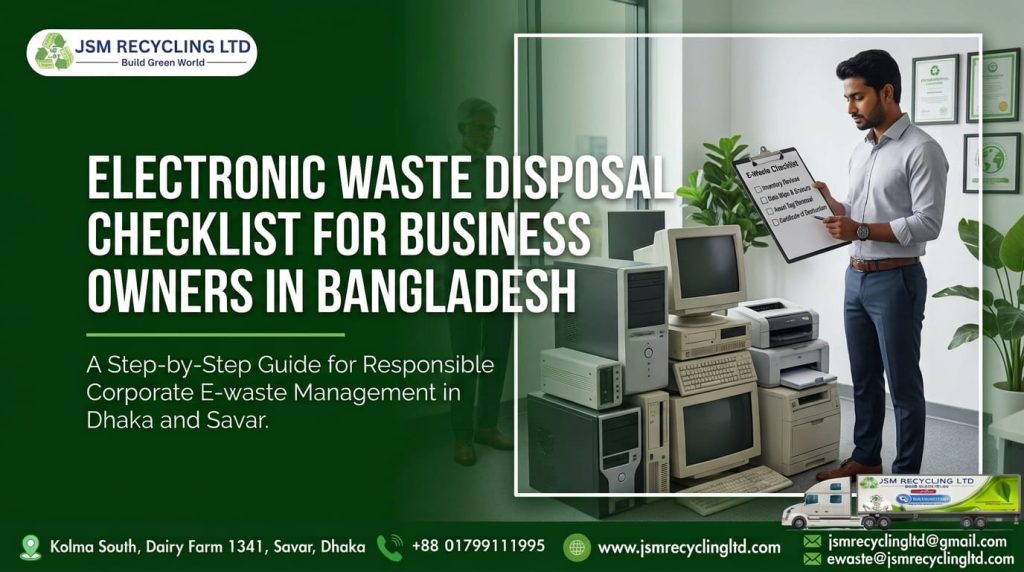
A Business Owner's Checklist for Safe Electronic Waste Disposal
⭐ Quick Answer
Safe electronic waste disposal for a business means inventorying old devices, backing up and wiping data securely, and handing everything to a government authorized recycler. Never sell devices to informal scrap dealers or throw them in regular trash. This checklist walks a business owner through every step, from planning to getting a data destruction certificate.
Electronic waste disposal is easy to postpone until a storeroom is overflowing with old computers. By then, the risk to your data and your business has already been building for months.
This checklist gives business owners in Bangladesh a clear, step-by-step way to handle old electronics safely, without guesswork.
Electronic waste disposal is the process of safely removing, wiping, and recycling devices a business no longer uses. Done correctly, it protects sensitive data, keeps you compliant with local rules, and prevents environmental harm. Done carelessly, it can expose your company to real risk.
A Simple Definition
Any device that plugs in, runs on batteries, or connects to a network becomes electronic waste once your business stops using it. Disposing of it properly means more than throwing it out — it means tracking it, wiping it, and recycling it responsibly.
Common Business Electronic Waste
Most companies underestimate how much of this they actually have sitting around.
- Desktops, laptops, and monitors
- Servers, hard drives, and backup drives
- Printers, scanners, and office phones
- Routers, switches, and networking cables
- UPS units and batteries
Now let’s move into the actual checklist.
This checklist covers everything from planning to final proof of disposal. Work through it in order, and keep records at each stage.
- Create an inventory. List every device by type, age, and which department used it.
- Flag data-bearing devices. Mark anything that stored files, emails, or client information.
- Back up what’s still needed. Move important files to secure storage before wiping anything.
- Choose secure data destruction over deletion. A factory reset alone is not enough for sensitive devices.
- Verify your recycler’s authorization. Confirm Department of Environment (DoE) registration before handing anything over.
- Schedule a proper pickup. Avoid letting staff carry devices out informally or sell them privately.
- Collect your certificates. Keep the data destruction certificate and disposal record on file.
- Update your asset register. Mark each device as disposed, with the date and recycler name.
- Review your process yearly. As your business grows, your disposal volume and needs will change too.
If you can check off every item here, your business is following a genuinely safe process.
Skipping steps in this checklist creates risk on three fronts: health, environment, and data security. Following it protects your business from all three, while also building trust with clients and partners.
The Health and Human Impact
Electronic devices contain toxic materials such as lead, mercury, and cadmium. When old equipment is dismantled informally, workers handling it are often exposed without any protective equipment.
Women are frequently involved in informal e-waste sorting in Bangladesh, and they face direct exposure to these hazards — Transparency International Bangladesh (TIB), 2025.
The Environmental and Business Impact
Improperly discarded electronics can leak toxic metals into soil and water over time. Beyond the environmental cost, clients and investors increasingly expect visible corporate sustainability, and a weak disposal process can raise uncomfortable questions during audits or partnerships.
The Hidden Danger: Data Left on “Wiped” Devices
Deleting files or performing a factory reset does not guarantee your data is gone. Recovery software can often retrieve information from a drive that looks empty.
Secure data destruction physically or digitally destroys storage media so nothing can be recovered, and a certificate proves it happened. Without that certificate, a resold laptop could quietly carry your company’s confidential files out the door.
Bangladesh generates a large volume of electronic waste every year, and most of it never reaches a licensed disposal process. Understanding this gap explains why a formal checklist matters more here than in many other markets.
How Big Is the Problem in Bangladesh?
The WEEE Society Bangladesh estimates the country generates 367 million kg of e-waste annually, or about 2.2 kg per person — WEEE Society Bangladesh, via Dhaka Tribune. That’s still well below the global average of 7.8 kg per person, meaning this figure is likely to keep rising as businesses digitize further — Global E-waste Monitor 2024.
What Is Happening Right Now in Bangladesh?
The Hazardous Waste (e-waste) Management Rules, 2021 set collection targets that rise over time, but enforcement remains weak in practice — Transparency International Bangladesh (TIB), 2025. Around 97% of e-waste is still processed informally, with only 3% reaching licensed recyclers — TIB, 2025.
TIB also found that 88% of people are unaware of proper e-waste disposal methods, and about half of the institutions registered with BTRC reportedly operate without DoE registration — TIB, 2025.
Why Informal Disposal Fails Businesses
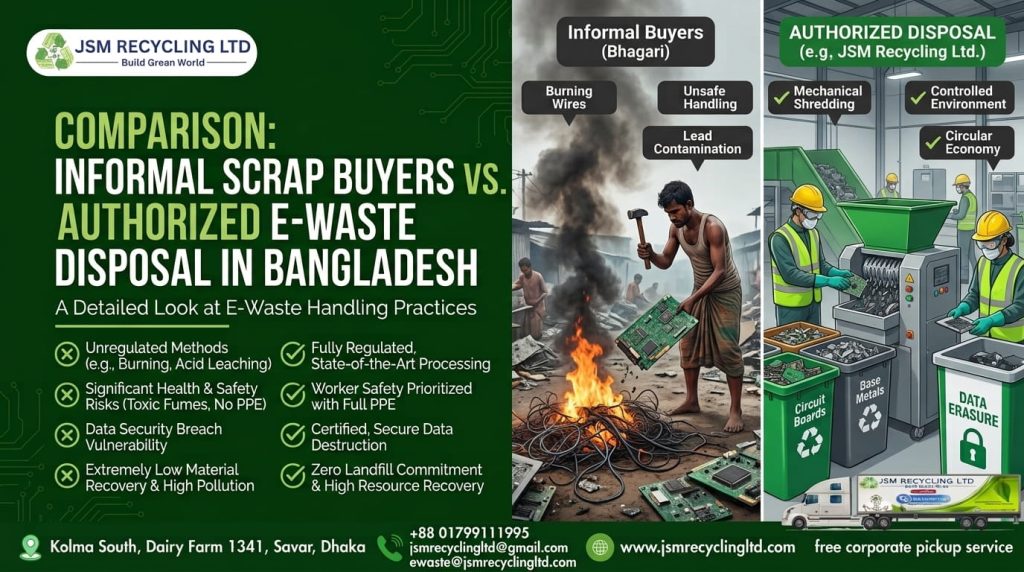
It may be tempting to let old equipment go to whichever scrap buyer offers the best price, but this shortcut usually skips every safeguard your business needs.
Factor | Informal Scrap Buyer | Government-Authorized Recycler |
Data safety | Devices often resold with data intact | Certified secure data destruction |
Legal standing | Usually unregistered | DoE-authorized |
Environmental handling | Dumping or open burning | 100% landfill-free processing |
Documentation | None | Certificates and disposal records |
Business risk | High (data, legal, reputational) | Low, with proof at every step |
With this understanding, let’s look at how to apply the checklist in practice.
How to Put This Checklist Into Practice
Putting the checklist to work means assigning ownership, setting a schedule, and choosing the right recycling partner from the start. This turns disposal from a once-a-year scramble into a routine process.
Best Practices for Ongoing Disposal
- Assign one person or team to own the process. This avoids devices slipping through the cracks.
- Set a recurring schedule. Quarterly or biannual reviews work well for most offices.
- Keep a simple disposal log. A spreadsheet with device, date, and recycler name is enough.
- Train staff not to self-dispose. Make it clear that all electronics go through the official process.
What to Prepare Before Every Disposal Round
Confirm your inventory is current, back up anything still needed, and separate batteries from other e-waste, since they require different handling.
Why Choose a Government-Authorized Company
A government authorized recycler gives your business legal protection and a paper trail you can show to auditors, clients, or regulators at any time.
- Compliance with the 2021 Rules
- Documentation for ESG or sustainability reporting
- Reduced risk of a data leak from resold equipment
- Confirmed landfill-free processing
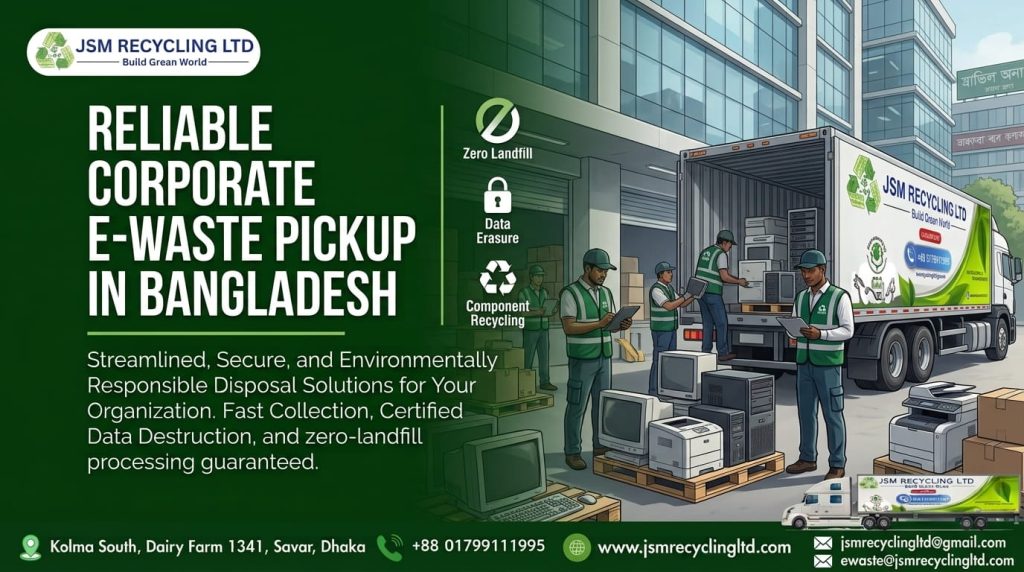
JSM Recycling Ltd is built to make every item on this checklist easy to complete. As a government-authorized recycler with over eight years of experience, it removes the guesswork from business electronic waste disposal.
Responsible Recycling
JSM Recycling Ltd has maintained 100% landfill-free operations for more than eight years, so items collected are processed responsibly rather than dumped.
Government Authorized and Data Destruction Certified
JSM Recycling Ltd holds Department of Environment (DoE) authorization and is data destruction certified. Every business client receives a verified data destruction certificate, giving you the exact proof this checklist calls for.
Free Corporate Pickup and Community Drop-Off Events
Businesses can schedule a free corporate pickup, which covers steps 6 and 7 of the checklist in a single, simple booking. JSM Recycling Ltd has also run more than 130 community drop-off events across Bangladesh, useful if smaller teams or individual employees need to dispose of personal devices too.
Turn This Checklist Into a Habit
Safe electronic waste disposal doesn’t need to be complicated once you have a checklist to follow. Inventory your devices, protect your data with proper destruction, and work only with a government-authorized recycler. Repeat this process regularly, and disposal becomes routine rather than a risk.
Contact JSM Recycling Ltd today — Bangladesh’s only 100% landfill-free, government authorized e waste recycling company. Schedule your free corporate pickup or find your nearest community drop-off event at jsmrecyclingltd.com
Frequently Asked Questions (FAQ)
Q: What is the correct way for a business to dispose of electronic waste?
A business should inventory its old devices, back up important data, use secure data destruction rather than simple deletion, and hand everything to a government-authorized recycler. Keeping a disposal record and certificate at every step is essential for compliance.
Q: What checklist should a company follow before recycling old office electronics?
Companies should list all devices, flag data-bearing ones, back up needed files, verify the recycler’s authorization, schedule a proper pickup, and collect a data destruction certificate afterward. Updating an asset register keeps this process auditable over time.
Q: What are the legal requirements for electronic waste disposal in Bangladesh?
Bangladesh regulates e-waste through the Hazardous Waste (e-waste) Management Rules, 2021, under the Bangladesh Environment Conservation Act, 1995. Businesses should give e-waste only to registered recyclers and confirm current requirements with the Department of Environment.
Q: Is deleting files enough before recycling a company laptop?
No, deleting files or performing a factory reset does not guarantee the data is unrecoverable. Certified secure data destruction, backed by a verified certificate, is the reliable way to protect sensitive business information.
Q: Does JSM Recycling Ltd provide a data destruction certificate for businesses?
Yes. JSM Recycling Ltd is data destruction certified and provides a verified certificate to every business client. It is also authorized by the Department of Environment (DoE) Bangladesh and operates 100% landfill-free.