
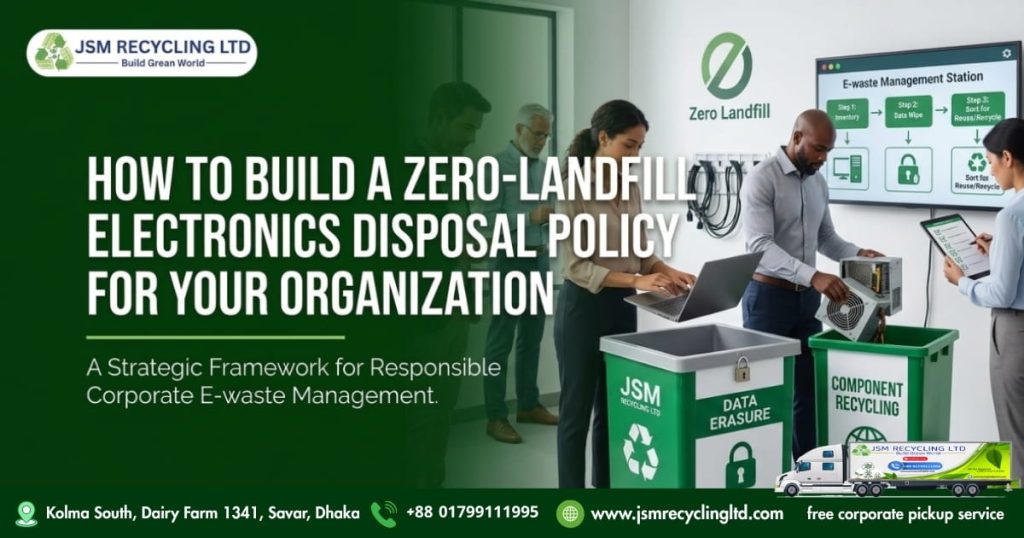
Implementing a Zero-Landfill Electronics Disposal Policy is no longer just an eco-friendly option for progressive businesses; it has become an absolute necessity for modern organizations operating across Bangladesh. Every year, millions of functional and broken devices are discarded into our rapidly overflowing local garbage streams. This guide will walk you through exactly how your organization can transition to a sustainable corporate framework, protect its proprietary data, and establish an effective electronic waste management strategy.
What is a Zero-Landfill Electronics Disposal Policy?
A Simple Explanation of Landfill-Free E-Waste Management
A zero-landfill electronic recycling policy is a formal corporate commitment ensuring that no obsolete, broken, or retired electronic devices enter municipal dumps or open landfills. Instead of tossing old IT assets into the regular trash, an organization commits to a closed-loop system.
[Old Electronics] ➔ [Certified Recycler] ➔ [Data Destruction] ➔ [Material Recovery] ➔ [0% Landfill Waste]
This structural framework guarantees that every single component—from the plastic casings to the precious metals inside the circuit boards—is systematically recovered, safely separated, and funneled back into the manufacturing supply chain.
Common Examples and Overview of Corporate E-Waste Policy
For a standard office in Dhaka or Chittagong, this policy dictates how everyday workplace equipment is treated at the end of its operational lifecycle. It establishes a mandatory protocol for handling items like aging desktop computers, outdated employee smartphones, server racks, and network routers.
Rather than allowing these items to gather dust in a storage closet or selling them off to unregulated local scrap vendors (known locally as bhangari shops), the policy outlines a strict path. It ensures all equipment undergoes secure data sanitization before being transferred directly to a certified e-waste recycler for complete material breakdown.
Key Categories of Electronics Addressed in the Policy
Information Technology (IT) and Telecommunications Equipment
This category represents the largest volume of workplace electronic waste generated by corporate offices, financial institutions, and multi-national firms across Bangladesh. It includes:
- Enterprise servers, mainframe components, and network switches
- Desktop computer towers, employee laptops, and computing tablets
- Corporate smartphones, office desk phones, and wireless routers
- Computer peripherals including keyboards, mice, and external hard drives
Consumer Electronics and Office Entertainment Systems
Modern corporate spaces utilize substantial amounts of consumer-grade electronics to keep their offices running efficiently. Items falling under this policy branch include digital television screens in conference rooms, display monitors, video conferencing setups, smart projectors, and breakroom appliances like microwave ovens and water dispensers.
Large and Small Office Appliances
Everyday printing, scanning, and climate control equipment forms a massive portion of heavy electronic scrap. This crucial category encompasses high-volume multi-function office printers, dedicated document scanners, paper shredders, and workplace air conditioning units, all of which contain complex electrical components and specialized chemical refrigerants.
Power Storage and Industrial Electrical Equipment
Uninterruptible Power Supplies (UPS) and heavy-duty backup batteries are vital for keeping Bangladeshi businesses online during frequent grid fluctuations. However, these systems present severe disposal risks, covering lead-acid backup batteries, specialized lithium-ion power packs, voltage stabilizers, industrial circuit breakers, and complex electrical wiring systems.
Why a Dedicated Electronics Disposal Policy Matters
Health and Human Impact Across Our Communities
When old devices are thrown into standard garbage bins, they eventually end up in massive open-air dumps like the Matuail landfill in Dhaka. Over time, heavy rains cause toxic elements like lead, cadmium, mercury, and flame retardants to leach deep into the surrounding soil and local groundwater systems.
According to a detailed WHO report on relevant health impacts, exposure to these unchecked toxins causes severe damage to human nervous systems, respiratory failure, kidney disease, and critical developmental issues in children who live near informal recycling clusters.
Environmental Degradation and Corporate Compliance Risks
Beyond the human toll, the environmental footprint of improper electronic disposal is catastrophic. Toxins bioaccumulate in local agricultural land and fishing waters, poisoning the regional food chain.
From a strict business perspective, dumping electronic waste now risks major legal penalties. The Bangladesh Department of Environment (DoE) has continually tightened environmental protection regulations, making corporate entities legally accountable for the downstream environmental damage caused by their discarded assets.
The Hidden Danger: Critical Data Security Vulnerabilities
Many Bangladeshi business owners mistakenly assume that performing a basic factory reset or deleting a folder completely wipes a computer’s hard drive. It does not.
Critical Security Risk: Standard data deletion leaves files fully retrievable using simple, freely available recovery software.
If your old corporate hard drives, employee laptops, or smartphones are sold to informal scrap dealers, your proprietary financial records, client databases, and sensitive HR files are highly vulnerable to data theft and corporate espionage. A comprehensive disposal policy mandates verified, physical data destruction before any hardware changes hands.
The Reality of E-Waste in Bangladesh
Navigating the Scale of the Local E-Waste Crisis
The sheer volume of electronic waste being generated locally is staggering. Data highlighted in the Global E-Waste Monitor 2024–2025 indicates that Bangladesh generates well over 3 million metric tons of electronic waste annually. As our national digital infrastructure expands and internet access grows, this number climbs significantly every single year.
🇧🇩 BANGLADESH E-WASTE REALITY
├── Total Annual Generation: >3,000,000 Metric Tons
├── Growth Rate: Accelerating year-over-year
└── Informal Recycling Rate: ~97% (Unregulated & Dangerous)
Current Disposal Habits Across the Country
Right now, the vast majority of local businesses and public institutions rely heavily on informal disposal routes. Old IT assets are frequently given away to general cleaning staff or sold directly to unregulated street vendors.
These informal operators have no training in environmental safety or data security. They are looking only for quick scrap value, leaving your company’s sensitive data exposed and creating significant corporate liability.
Why Informal Recycling Methods Are Failing Bangladesh
The primitive methods used by informal scrap yards are incredibly dangerous. Workers routinely burn plastic casings and use open acid baths in residential neighborhoods to strip out valuable copper and gold from circuit boards.
This crude approach recovers only a fraction of the raw materials while releasing highly toxic dioxins into our urban air. It ruins the local environment, endangers vulnerable workers, and leaves corporate data completely unprotected.
Best Practices for Implementing Your Disposal Policy
Step-by-Step Strategic Corporate Implementation
For an electronic recycling policy to work effectively, it needs to be integrated directly into your company’s standard operating procedures. The following structure outlines how to build a reliable workflow:
1.Conduct an Internal IT Asset Audit:Initial Assessment.
Document every single piece of electronic equipment across your organization. Record the serial numbers, current operational status, and physical location of all computers, servers, and peripherals.
2.Establish Centralized E-Waste Collection Points:Infrastructure Setup.
Set up clearly marked, secure bins within your facilities dedicated solely to broken or obsolete electronics. Ensure these collection zones are monitored to prevent device theft or tampering.
3.Mandate Verified Data Destruction Protocol:Security Compliance.
Require all data-bearing devices to undergo certified, physical destruction or industrial-grade degaussing. Never allow a drive to leave your premises without a clear data sanitization record.
4.Partner with an Authorized Recycling Company:Final Execution.
Arrange formal collection cycles with a government-authorized recycling firm that guarantees 100% landfill-free material processing and provides official certificates of destruction.
Essential Measures to Take Before Recycling Corporate Hardware
Before handing any workplace devices over to an external collection team, your internal IT department must complete three foundational tasks:
- Backup All Critical Files: Back up all essential business data to secure corporate cloud storage or protected external drives.
- Remove Organizational Assets: Remove all physical corporate asset tags, company stickers, and inventory tracking labels from the outer casings.
- Log Serial Numbers: Compile a finalized log of the exact serial numbers of every device being retired for your compliance records.
Why Your Policy Must Specify a Government-Authorized Partner
A zero-landfill policy is only as strong as the partner executing it. Working with an unverified vendor completely breaks your chain of custody.
A DoE-authorized recycling firm operates under strict state audits and international environmental guidelines. They provide legal documentation proving your equipment was handled safely, keeping your company compliant with national environmental laws and fully protected against data leaks.
Comparison of Disposal Methods
Disposal Attribute | Informal Scrap Vendors (Bhangari) | Certified E-Waste Partners |
Data Security Cover | None (High risk of recovery and leakage) | 100% Guaranteed (Physical shredding) |
Landfill Prevention | 0% (Heavy tipping of toxic residues) | 100% Landfill-Free (Complete recovery) |
Legal Documentation | None | Official Destruction Certificates |
Environmental Safety | Open acid baths and hazardous burning | State-of-the-art eco-friendly refining |
How JSM Recycling Ltd is Solving Bangladesh's E-Waste Problem
A Deep Commitment to Responsible E-Waste Recycling
JSM Recycling Ltd stands at the absolute forefront of industrial electronic waste reduction and green processing in Bangladesh. Operating with a strict zero-landfill mandate, JSM ensures that 100% of the electronic scrap received is carefully dismantled and recycled into industrial raw materials. Over 8+ years of dedicated operations, the company has successfully diverted thousands of tons of toxic electronic scrap away from vulnerable Bangladeshi ecosystems.
Government Authorized and Data Destruction Certified
As a premier, fully authorized e-waste recycler under the Bangladesh Department of Environment (DoE), JSM Recycling Ltd provides corporate clients with complete peace of mind. JSM specializes in military-grade safe electronic waste disposal and high-security data destruction.
Every business client receives a verified, legally binding Data Destruction Certificate and an official Eco-Recycling Certificate, providing definitive proof that your corporate liabilities have been completely managed.
Free Corporate Pickup and Community Drop-Off Events
JSM makes it simple for organizations to maintain an effective responsible e-waste disposal workflow. They offer comprehensive corporate pickup solutions tailored directly for offices, banks, factories, and NGOs throughout the country.
Furthermore, demonstrating their deep commitment to public environmental awareness, JSM has hosted 130+ community events held across Bangladesh, helping businesses, schools, and neighborhoods clean out their old devices safely and responsibly.
Building a Zero-Landfill Electronics Disposal Policy is a definitive step toward safeguarding your company’s proprietary data while protecting the future of our local environment. By moving away from informal scrap practices and committing to a structured e-waste recycling program, your organization sets a powerful benchmark for corporate responsibility in Bangladesh. Do not leave your old IT assets sitting in storage or exposed to unverified disposal channels.
Contact JSM Recycling Ltd today—Bangladesh’s only 100% landfill-free, government-authorized e-waste recycling company. Schedule your free corporate pickup or find your nearest community drop-off event at jsmrecyclingltd.com to confidently secure your data and protect our communities.
Frequently Asked Questions (FAQ)
What exactly is a Zero-Landfill Electronics Disposal Policy?
It is a formal corporate operational policy that guarantees an organization will recycle 100% of its obsolete electronic items through a certified recycling firm, ensuring zero electronic waste enters local trash streams or landfills.
What are the main risks of throwing corporate electronics in the regular trash?
The primary threats are severe corporate data leaks from un-shredded storage drives, environmental contamination from toxic chemicals leaching into local groundwater, and hefty financial fines from regulatory bodies like the DoE.
What does Bangladesh law say about corporate electronic waste disposal?
The Bangladesh Department of Environment mandates that electronic waste must be processed through government-approved channels. Companies found dumping hazardous e-waste into public landfills face direct legal prosecution and severe financial penalties.
How can a business in Dhaka safely set up an e-waste recycling program?
Your business can easily build a sustainable program by running an internal hardware audit, setting up secure on-site collection bins, and partnering with an authorized specialist like JSM Recycling Ltd for automated corporate collections.
Does JSM Recycling Ltd provide an official certificate after destroying our old data?
Yes, absolutely. JSM Recycling Ltd provides a verified Data Destruction Certificate alongside an official Eco-Recycling Certificate upon the completion of every project, ensuring your business stays fully compliant with all local data security and environmental laws.