
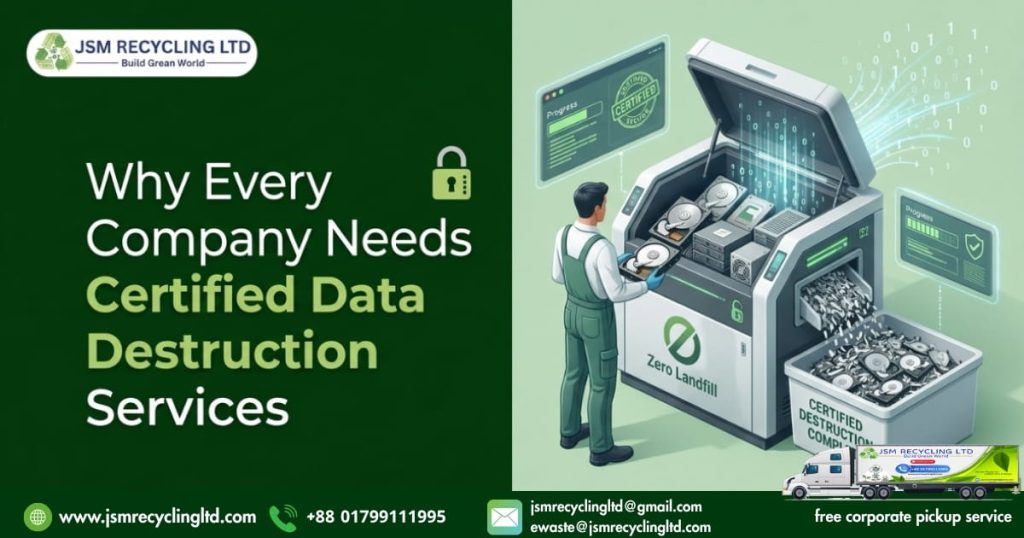
Deleting a file only hides it from view — the data itself stays on the drive and can be pulled back with free recovery software. This is the core difference in the data destruction vs data deletion debate: destruction physically or permanently erases the storage media so nothing can ever be rebuilt. Every company that handles customer records, payroll, or financial data needs certified data destruction services, not a simple delete key, before any device leaves the office. JSM Recycling Ltd, a government-authorized e-waste recycler, offers this protection with a verifiable certificate. |
If your office in Dhaka, Chattogram, or anywhere in Bangladesh has ever thrown out an old laptop, server, or hard drive, this article is for you. Most business owners assume that clicking “delete” or formatting a drive is enough to protect company secrets. It is not. This is exactly why data destruction services Bangladesh companies rely on exist — to close the gap between what feels safe and what is actually safe. Understanding data destruction vs data deletion could be the difference between a normal workday and a serious data breach.
What Is the Difference Between Data Destruction and Data Deletion?
Data deletion removes a file’s address from the operating system’s index, but the actual information stays on the drive until new data overwrites it. Data destruction permanently eliminates that information through physical shredding, degaussing, or certified wiping, so recovery becomes impossible. Only true destruction protects sensitive business data for good. |
Think of a filing cabinet. Deleting a file is like removing its label from the drawer index — the folder is still sitting inside. Anyone who knows where to look can find it in minutes.
Data destruction, on the other hand, is like shredding the folder itself. There is nothing left to find, no matter how hard someone looks. That is the standard every business should be working toward.
The Hidden Danger: Forensic Recovery From "Deleted" Drives
This is the part most office managers never learn until it is too late. Forensic data recovery tools — many of them free and downloadable in minutes — can pull back “deleted” spreadsheets, client databases, and financial records from a hard drive that looks completely empty.
A discarded company laptop can hold years of invoices, employee salary details, client contracts, and login credentials. If that laptop is sold, donated, or dumped without proper wiping, all of that information is one recovery scan away from a stranger’s screen.
This hidden danger is exactly why secure data destruction is treated as a business risk issue, not just an IT chore.
Why Is Informal E-Waste Recycling a Data Security Risk in Bangladesh?
Most of Bangladesh’s electronic waste is collected by informal scrap dealers who dismantle devices for scrap metal value, not for data safety. Storage drives are often resold or repaired instead of destroyed, meaning company data can resurface months or years later. Without certified handling, businesses lose all control over where their information ends up.
Bangladesh generates a large and fast-growing volume of electronic waste each year, and the Global E-Waste Monitor has repeatedly flagged South Asia’s low formal collection rates as a regional weak point. Industry estimates suggest that only a small fraction of e-waste in Bangladesh passes through certified, government-authorized recyclers — the rest moves through informal channels where data-bearing components are rarely wiped or destroyed.
This is the real threat behind business e-waste recycling in Bangladesh: it is not only about the environment, it is about who ends up holding your company’s data next.
What Happens When Business Data Is Not Properly Destroyed?
Improperly discarded devices can lead to leaked customer records, stolen financial data, identity theft, and exposed business strategies. Companies also face reputational damage, loss of client trust, and possible legal penalties under Bangladesh’s data protection expectations. The cost of a breach almost always outweighs the cost of proper disposal. |
A single recovered hard drive can expose:
- Customer names, phone numbers, and payment details
- Employee salary records and national ID information
- Confidential contracts and vendor pricing
- Internal emails, passwords, and login credentials
For any company handling client or patient information — healthcare providers, financial firms, and corporate offices alike — this risk is simply not worth taking.
Is Certified Data Destruction Legally Necessary for Bangladeshi Businesses?
While Bangladesh’s data protection framework is still developing, businesses are increasingly expected to show due diligence in protecting customer and employee data, especially in banking, healthcare, and telecom sectors. A destruction certificate provides documented proof of compliance during audits, client vetting, or investigations. It also protects the company from liability if a device is later linked to a data leak.
Even where formal regulation is still catching up, most international clients and partners now ask Bangladeshi vendors for proof of secure IT asset disposal before signing contracts. Having a certificate on file is quickly becoming a basic cost of doing business.
Safe vs. Unsafe Disposal Methods: A Quick Comparison

Use this table to check how your office currently handles retired electronics.
Unsafe Disposal Method | Safe / Certified Disposal Method |
Selling old computers to informal scrap (bhangari) dealers | Handing devices to a government-authorized e-waste recycler like JSM Recycling |
Deleting files or formatting the drive and assuming data is gone | Physical shredding, degaussing, or certified wiping with a destruction certificate |
Throwing hard drives in general office waste | Scheduling a documented corporate pickup with chain-of-custody tracking |
Donating devices without wiping storage first | Data destruction before reuse, resale, or donation |
No paperwork or proof of disposal | Certificate of Data Destruction for audit and compliance records |
How Does Certified Data Destruction Work?
Certified data destruction follows a documented, step-by-step process: devices are collected, logged, wiped or physically destroyed using approved methods, and then confirmed with a signed certificate. Every step is tracked so the business has a clear paper trail. This process turns a simple office clean-out into an audit-ready, secure procedure.
- Corporate pickup is scheduled and every device is logged by serial number.
- Devices are transported under chain-of-custody to a licensed facility.
- Storage drives are wiped, degaussed, or physically shredded, depending on the device and client requirement.
- Remaining components are separated for environmentally responsible, landfill-free recycling.
- A Certificate of Data Destruction is issued to the company for its records.
Why Choose JSM Recycling Ltd for Data Destruction Services in Bangladesh?

JSM Recycling Ltd is a government-authorized e-waste recycler with more than 8 years of experience and a 100% landfill-free process. The company has run 130+ community e-waste collection events across Bangladesh and provides certified data destruction alongside responsible IT asset disposal. Businesses get both data security and environmental compliance in a single service.
For corporate offices, choosing a partner with a proven track record matters. JSM Recycling Ltd combines government authorization, over 8 years of hands-on experience, and a genuinely 100% landfill-free process — meaning retired devices never simply end up buried or dumped. With 130+ community events held across the country, JSM has also built deep, on-the-ground experience in collecting and safely processing electronics at scale, from single-office pickups to large corporate IT refreshes.
Whether your business needs a one-time secure wipe of retiring laptops or an ongoing electronic waste recycling partnership, working with an authorized, certified provider is the only way to close the loop safely.
Don't Let "Delete" Give You False Confidence
The debate over data destruction vs data deletion is not a technical detail — it is a business risk decision. Every company that retires a computer, server, or phone is making a choice about where its data ends up next. Choosing certified data destruction services in Bangladesh over a simple delete key is the difference between a clean, documented exit for your old equipment and a data breach waiting to happen.
Contact JSM Recycling Ltd today — Bangladesh’s only 100% landfill-free, government-authorized e-waste recycling company. Schedule your free corporate pickup or find your nearest community drop-off event at jsmrecyclingltd.com
Frequently Asked Questions
What is the difference between data destruction and data deletion?
Data deletion hides a file from view but leaves the underlying data recoverable on the drive. Data destruction permanently erases the data through physical or certified digital methods, making recovery impossible.
Why do businesses need certified data destruction services?
Businesses need certified data destruction to prevent leaked customer records, comply with client and audit requirements, and avoid the legal and reputational damage caused by a data breach.
How does certified data destruction work?
Devices are collected, logged, and either wiped, degaussed, or physically shredded at a licensed facility, after which a signed Certificate of Data Destruction is issued to the business.
Is data destruction legally required in Bangladesh?
Formal data protection regulation in Bangladesh is still developing, but businesses in banking, healthcare, and telecom are increasingly expected to prove secure data handling, making certified destruction a practical necessity.
Does JSM Recycling Ltd provide a certificate for data destruction?
Yes. JSM Recycling Ltd issues a Certificate of Data Destruction for every corporate pickup, giving businesses documented proof for audits and compliance records.