
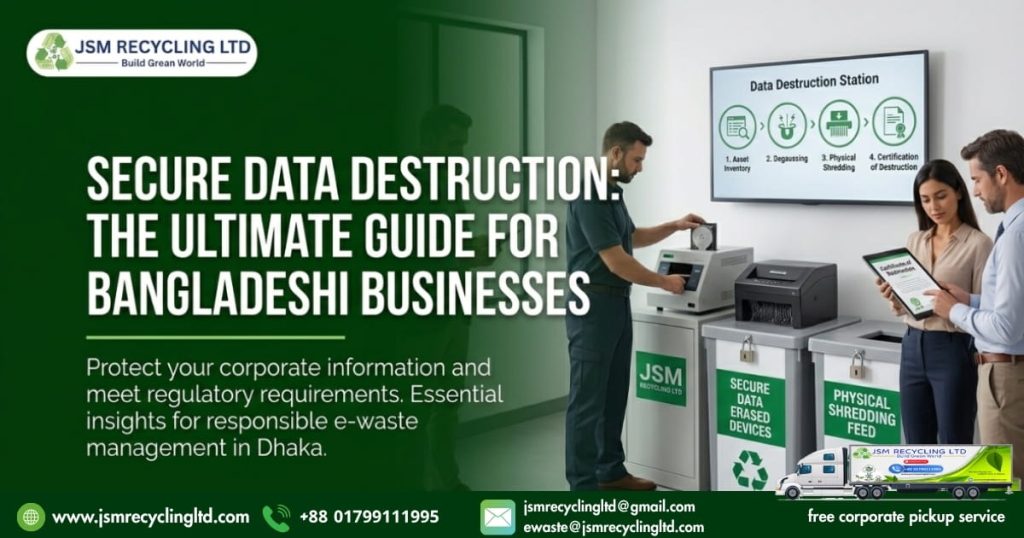
Secure Data Destruction: The Ultimate Guide for Bangladeshi Businesses
Corporate data breaches are rising rapidly across Bangladesh, making professional data destruction a critical priority for every organization. Every modern business, bank, and NGO handles massive amounts of sensitive information daily. When you upgrade your office computers, your old hard drives remain a massive security risk. Simply deleting your files does not protect your organization from corporate espionage or identity theft.
Furthermore, improper disposal of electronic waste severely damages our local environment. Throwing old storage devices into regular landfills releases toxic chemicals into our soil and water supply. Bangladeshi businesses must now balance data security risks with environmental responsibility and local legal compliance.
To safeguard your reputation, you need a certified data destruction service. Partnering with a government-authorized e-waste recycling company ensures your digital footprint is permanently erased. This comprehensive guide explains how to secure your corporate assets while protecting Bangladesh’s environment.
What is Data Destruction?
Data destruction is the process of permanently destroying data on hardware devices so it becomes completely unreadable and impossible to recover. Certified data destruction utilizes specialized physical shredding, degaussing, or digital wiping methods. This process guarantees that sensitive corporate information remains safe from unauthorized access during device disposal.
KEY TAKEAWAYS
- Simple file deletion leaves your data highly vulnerable to cybercriminals.
- Physical hard drive shredding provides the highest level of data security.
- Uncertified e-waste informal recycling causes severe environmental pollution in Bangladesh.
- Government-authorized recyclers provide an official Certificate of Destruction for legal audits.
- Safe IT asset disposal protects your brand from devastating financial loss.
TABLE OF CONTENTS
- What is Data Destruction?
- Types of Data Destruction Services
- Why Certified Data Destruction Matters
- Hidden Data Security Risks
- The Bangladesh E-Waste and Cyber Risk Context
- How to Choose a Certified Data Destruction Service
- Comparison: Certified vs. Uncertified Providers
- Best Practices Before Device Disposal
- Why Government Authorization Matters
- How JSM Recycling Ltd Solves the Problem
- Frequently Asked Questions
Types of Data Destruction Services
Simple Explanation
Different storage devices require specific methods to ensure permanent erasure. Selecting the right method depends on your security compliance needs and whether you intend to reuse the hardware.
Real-World Examples
A commercial bank in Dhaka must physically shred hard drives containing old financial records. Conversely, a software company might use digital wiping on leased laptops before returning them to the vendor.
Why Businesses Need It
Using the correct data disposal method ensures full cybersecurity compliance. It prevents data recovery by unauthorized third parties while streamlining your corporate IT asset management.
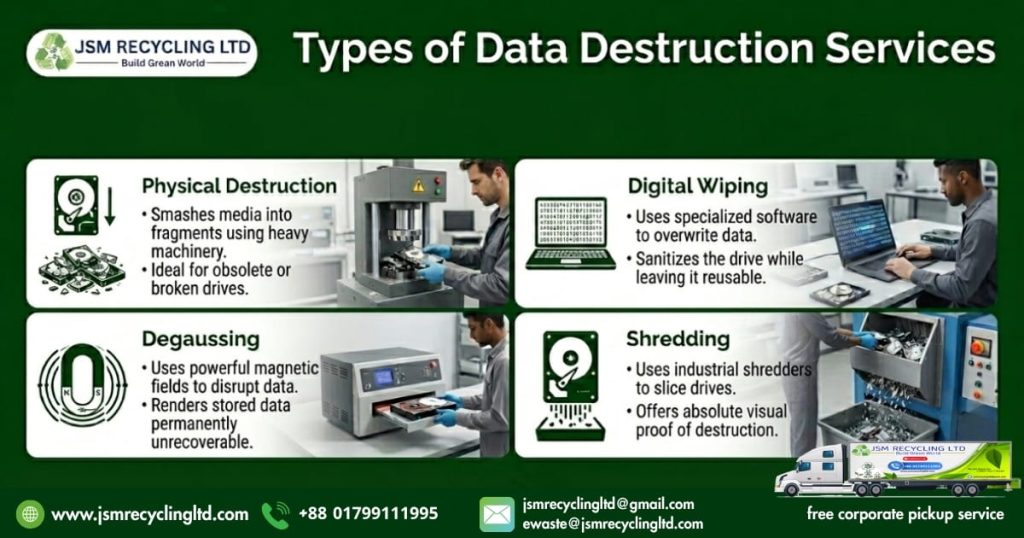
Physical Destruction
Physical destruction involves breaking the storage media into tiny pieces using heavy machinery. This method is the most reliable way to handle obsolete or broken storage drives.
Digital Wiping
Digital wiping uses specialized software to overwrite existing data with random binary patterns. This method sanitizes the drive completely while leaving the physical hardware fully reusable.
Degaussing
Degaussing exposes magnetic media to high-intensity magnetic fields. This process completely disrupts the magnetic domains on the disk, rendering the stored data permanently unrecoverable.
Shredding
Hard drive shredding utilizes heavy industrial shredders to slice drives into small metal fragments. It provides absolute visual proof that your sensitive information protection is complete.
Data Disposal Methods
Method | Security Level | Cost | Best Use |
Physical Shredding | Highest Security | Moderate | Obsolete hard drives, SSDs, and backup tapes. |
Digital Wiping | High Security | Low | Functional drives intended for corporate reuse. |
Degaussing | Very High | Moderate | Magnetic hard drives and old tape storage. |
Why Certified Data Destruction Matters
Many corporate managers assume that hitting “delete” or formatting a drive provides adequate data security. However, standard operating systems only remove the file pathways, leaving the actual data fully intact on the drive. Anyone with free data recovery software can easily retrieve these supposedly deleted files.
Uncertified data disposal exposes your business to extreme financial loss and severe reputation damage. If customer records or proprietary trade secrets leak, your organization could face devastating lawsuits. Cybersecurity experts agree that certified data destruction is the only foolproof way to prevent a post-disposal data breach.
Did You Know? Cybercriminals frequently buy old corporate computers from informal markets specifically to extract sensitive corporate emails and banking passwords.
Hidden Data Security Risks
Modern office equipment contains hidden storage drives that many business managers completely overlook. For instance, office printers and photocopier storage units retain digital copies of every document scanned. If you dispose of these machines improperly, you leave a goldmine of sensitive information exposed.
Furthermore, solid-state drives (SSDs) require different data sanitization techniques than traditional hard disk drives. Standard degaussing does not work on flash memory, meaning SSD recovery remains possible unless physically shredded.
[Old Office IT Asset] ➔ [Informal Scrap Yard] ➔ [Data Extraction via Software] ➔ [Corporate Data Breach]
Your corporate servers, mobile phones, USB drives, and cloud backup systems all carry significant data security risks. Leaving your old hardware unmanaged creates a massive vulnerability in your cybersecurity defense system.
The Bangladesh E-Waste and Cyber Risk Context
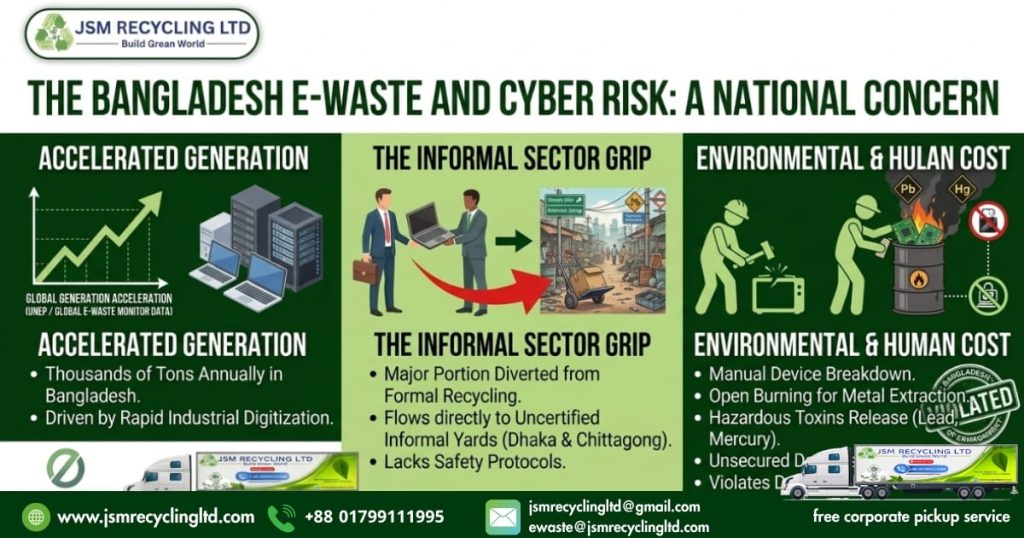
┌────────────────────────────────────────┐
│ Bangladesh Corporate E-Waste Threat │
└───────────────────┬────────────────────┘
│
┌────────────────┴────────────────┐
▼ ▼
┌─────────────────────────┐ ┌─────────────────────────┐
│ Informal Sector │ │ Cybersecurity Void │
│ • Severe Air Pollution │ │ • Data Recovered easily│
│ • Toxic Lead Leaching │ │ • Corporate Blackmail │
│ • Human Health Hazards │ │ • Financial Fraud Risk │
└─────────────────────────┘ └─────────────────────────┘
Simultaneously, the World Health Organization (WHO) and the International Telecommunication Union (ITU) highlight the growing intersection of electronic waste and cyber vulnerability. Without formal corporate asset disposal infrastructure, Bangladeshi enterprises remain highly exposed to international data theft networks.
How to Choose a Certified Data Destruction Service
Pro Recommendation
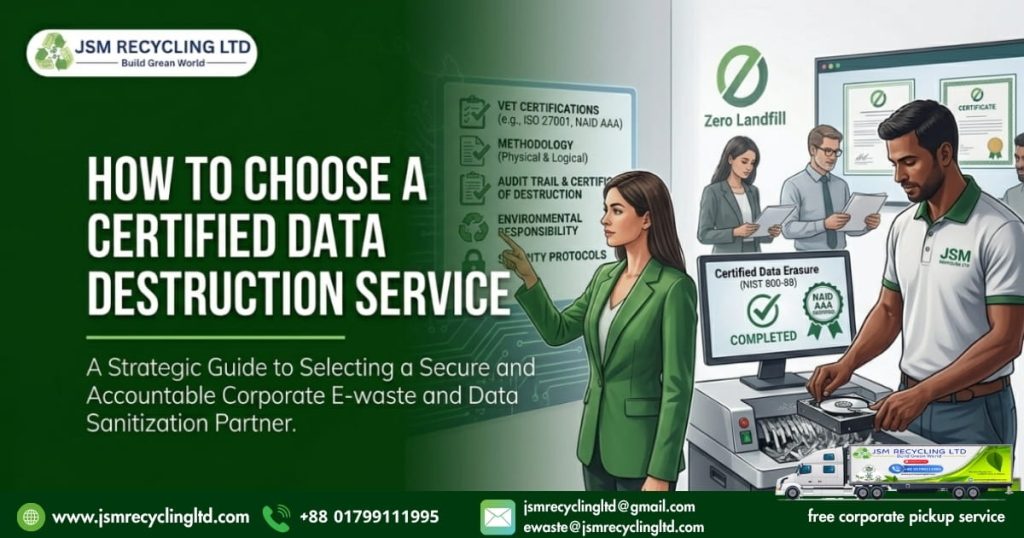
Never hand over corporate storage media without verifying the provider’s legal credentials. A professional data destruction company must provide a transparent, auditable process from start to finish.
Checklist for Verifying Secure Data Destruction Vendors
- [ ] Government Authorization: Possession of valid licenses from the Department of Environment.
- [ ] Certificate of Destruction: Formal documentation delivered after the shredding process.
- [ ] Chain of Custody: Secure tracking of your assets from your office to the facility.
- [ ] Professional Equipment: Utilization of industrial-grade shredders or degaussers.
- [ ] Secure Transportation: Locked vehicles to prevent loss during transit.
- [ ] Audit Trail: Transparent video recording or physical logging of the destruction.
- [ ] Environmental Responsibility: A strict commitment to 100% landfill-free recycling
Comparison Table: Choosing Your Provider
Certified Provider
Uncertified Provider
Issues an official Certificate of Destruction
Gives no legal documentation or proof
Authorized by the Department of Environment
Operates illegally within the informal sector
Guarantees absolute data breach prevention
Leaves data vulnerable to recovery tools
Uses sealed, tracked transport vehicles
Transports assets via open rickshaws or vans
Features highly trained, vetted technicians
Employs untrained daily labor
Maintains a 100% landfill-free policy
Dumps hazardous chemical waste into local rivers
Uses industrial-grade hard drive shredding
Smashes electronics manually with hammers
Provides complete corporate audit trails
Offers zero accountability for lost assets
Follows strict global eco-friendly standards
Burns plastics openly, causing air pollution
Protects your corporate brand reputation
Exposes your business to massive legal fines
Best Practices Before Device Disposal
Before scheduling your secure data disposal service, your IT department should follow strict preparation protocols. First, create a secure cloud backup of all vital business files. Next, log out of all corporate network accounts and remove hardware tracking software from the devices.
[Backup & Encrypt Drive] ➔ [Log Out of Accounts] ➔ [Inventory & Tag Assets] ➔ [Handover to JSM Recycling]
Always perform full disk encryption on the drives before they leave your corporate facility. Ensure your team creates a precise inventory list containing the serial numbers of every single hard drive. This rigorous tracking guarantees that no storage media goes missing during the logistics process.
Why Government Authorization Matters
Partnering with a Department of Environment (DoE) approved recycling company protects your business from legal liability. Bangladesh is steadily tightening its environmental protection and digital security frameworks. Using unauthorized vendors can result in severe regulatory penalties for corporate pollution.
Government authorization ensures that the recycling facility operates under strict occupational health and safety standards. It guarantees that corporate electronic waste is processed using clean, sustainable methods. Ultimately, official compliance builds long-term trust with your international investors, clients, and regulatory authorities.
How JSM Recycling Ltd Solves the Problem
JSM Recycling Ltd is the premier government-authorized e-waste recycling company operating in Bangladesh. With over 8 years of operational excellence, JSM provides world-class data destruction and eco-friendly electronic waste processing. The company strictly follows a 100% landfill-free policy, ensuring zero environmental harm.
┌────────────────────────────────────────────────────────┐
├────────────────────────────────────────────────────────┤
│ 1. Secure Corporate Pickup │
│ 2. Tracked Chain of Custody │
│ 3. Industrial Hard Drive Shredding │
│ 4. Issuance of Official Certificate of Destruction │
│ 5. 100% Landfill-Free Eco-Friendly Material Recovery │
└────────────────────────────────────────────────────────┘
JSM has organized more than 130 community events to raise ecological awareness across the nation. They offer tailored corporate pickup solutions designed specifically for large enterprises, banks, and non-governmental organizations. By choosing JSM, your business achieves ironclad data security while contributing directly to a cleaner, greener Bangladesh.
Protecting your sensitive corporate information requires proactive, certified data destruction practices. Leaving old hard drives in storage closets or selling them to informal scrap dealers invites disastrous cyber threats. Secure data disposal shields your business from financial damage while preserving operational integrity.
By choosing an authorized recycling partner like JSM Recycling Ltd, you achieve total peace of mind. Your confidential records are permanently destroyed, and your electronic waste is recycled sustainably. Take immediate action today to safeguard both your digital assets and our local environment.
Final Verdict: Contact JSM Recycling Ltd today — Bangladesh’s only 100% landfill-free, government-authorized e-waste recycling company. Schedule your free corporate pickup or find your nearest community drop-off event at jsmrecyclingltd.com to secure your corporate assets responsibly.
Frequently Asked Questions
What is certified data destruction?
Certified data destruction is a verified process where digital storage devices are rendered permanently unreadable. It utilizes professional industrial machinery and specialized software to ensure data cannot be recovered. The entire sequence is documented, resulting in an official compliance certificate issued to the business.
Is deleting files enough?
No, deleting files or formatting your hard drive is never enough. Standard deletion only hides file locations but leaves the actual data intact on the disk storage media. Skilled data recovery specialists can easily retrieve this information unless the drive is physically destroyed or digitally overwritten.
Is data destruction legally required?
Yes, data destruction is increasingly mandated by global data protection laws and evolving digital security regulations in Bangladesh. Financial institutions, medical facilities, and corporations are legally obligated to safeguard sensitive consumer data. Proper data sanitization protects organizations from regulatory penalties, audits, and corporate lawsuits.
How are hard drives destroyed?
Hard drives are typically destroyed using heavy industrial shredders that cut the metal platters into tiny fragments. Alternatively, they can be processed using high-powered degaussers that completely neutralize the magnetic fields holding the data. Both procedures make data recovery physically impossible.
Can deleted files be recovered?
Yes, deleted files can easily be recovered using basic software if the physical media remains undamaged. Only industrial-grade hard drive shredding or advanced digital overwriting guarantees that data recovery is rendered impossible. Taking shortcuts with old hardware leaves your corporate secrets exposed.
What certificate is provided?
A formal Certificate of Destruction is provided after the data sanitization process is completed. This legal document lists the specific serial numbers of the destroyed storage assets, along with the date and method used. It serves as essential proof for internal corporate audits and regulatory compliance.
Why use government-authorized recyclers?
Government-authorized recyclers operate under strict ecological and safety guidelines monitored by the Department of Environment. They guarantee that toxic electronic components do not pollute the air or water systems. Authorized providers offer an audit trail that protects your business from legal liabilities.
How can businesses dispose of old IT equipment safely?
Businesses can dispose of old IT equipment safely by partnering with an authorized corporate asset disposal provider like JSM Recycling Ltd. Your IT department should log your assets, encrypt the drives, and request a secure corporate pickup. The provider then safely shreds all data-bearing devices and recycles the physical components.