
The laptop recycling process is one of the most critical yet misunderstood steps in responsible e-waste management — and in Bangladesh, getting it right has never been more urgent.
Every year, millions of laptops reach the end of their usable life. Businesses replace aging fleets. Students upgrade their devices. Government offices retire outdated equipment. But what happens to those old machines after they leave your desk? If they end up in a landfill — as far too many do — the consequences for human health, the environment, and data security can be severe.
Whether you are a corporate IT manager, a government official, a student, or simply a responsible citizen, understanding how laptop recycling actually works empowers you to make better decisions for your organization and your planet.
This guide breaks down the complete laptop recycling process from start to finish, with a specific focus on Bangladesh’s regulatory environment, best practices, and how certified recyclers like JSM Recycling Limited are leading the way toward a cleaner, safer future.
✅ Quick Answer Box
What is the laptop recycling process?
The laptop recycling process involves collecting end-of-life laptops, securely erasing or destroying all stored data, physically dismantling the device, sorting materials by type (metals, plastics, glass, batteries), and responsibly recovering or safely disposing of each component. Certified recyclers in Bangladesh ensure zero landfill outcomes and provide verified certificates of destruction.
📚 Table of Contents
- What Is the Laptop Recycling Process?
- Types of Laptop Recycling
- Why the Laptop Recycling Process Matters
- Bangladesh Context: E-Waste Crisis and Opportunity
- Common Mistakes in Laptop Disposal
- Myths vs. Facts About Laptop Recycling
- Safe vs. Unsafe Laptop Disposal Methods
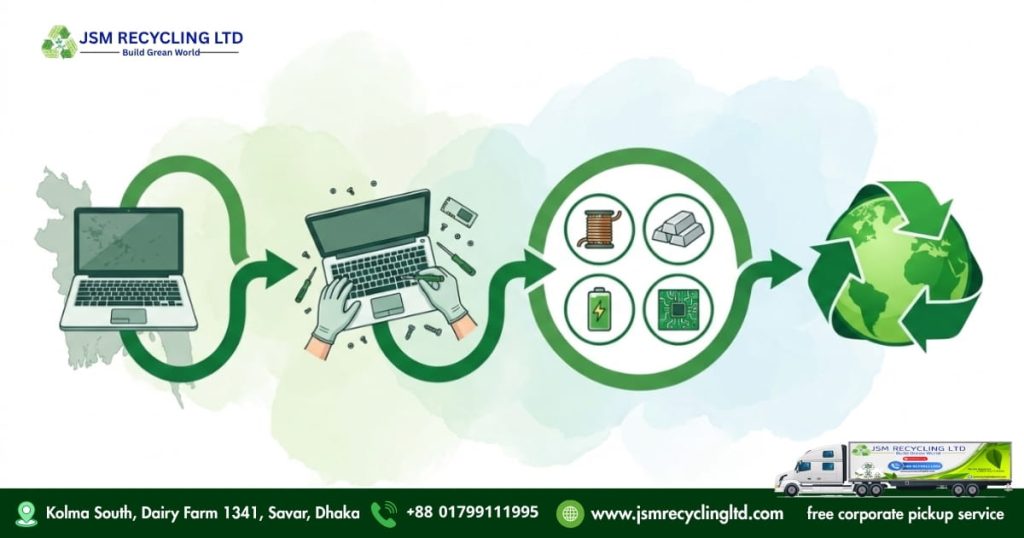
- Step-by-Step: How the Laptop Recycling Process Works
- Expert Tips for Businesses and Organizations
- Future Trends in Laptop Recycling
- How JSM Recycling Limited Solves This Problem
- Key Takeaways
- Conclusion
- Frequently Asked Questions (FAQs)
What Is the Laptop Recycling Process?
Definition
The laptop recycling process refers to the structured, multi-stage system used to collect, dismantle, decontaminate, and recover materials from end-of-life laptops and other portable computers. It is a specialized branch of electronic waste (e-waste) management that requires certified handling due to the hazardous materials found inside modern laptops.
Simple Explanation
Think of it like this: a laptop is not just plastic and metal. Inside a single device, you will find lithium-ion batteries, lead solder, mercury (in older screens), cadmium, chromium, and other toxic substances. The recycling process ensures that these materials are handled safely — not dumped in open land or burned — while recovering valuable resources like copper, aluminum, gold, and rare earth metals.
Real-Life Example
When a Dhaka-based law firm retires 50 laptops at the end of a financial year, those machines contain sensitive client data, toxic battery cells, and hundreds of grams of recoverable copper and aluminum. A certified recycler like JSM Recycling Limited picks up the devices, issues a collection receipt, performs certified data destruction, disassembles each laptop, separates materials, and provides the firm with verified certificates of data destruction and recycling. The firm stays compliant, protects client confidentiality, and contributes nothing to the landfill.
Types of Laptop Recycling
Not all laptop recycling looks the same. Depending on the condition of the device and the organization’s needs, different approaches apply.
1. Refurbishment and Resale
If a laptop is still functional, certified recyclers assess it for refurbishment. The device is cleaned, repaired, tested, and resold — extending its useful life and reducing demand for new raw materials. This is the most resource-efficient option.
2. Component Harvesting
When a laptop can no longer function as a complete unit, individual components — hard drives, RAM modules, screens, keyboards, power adapters — may still be functional and can be extracted for reuse in other devices or sold as spare parts.
3. Material Recovery Recycling
When components cannot be reused, the laptop is dismantled and materials are separated by type. Metals such as copper, aluminum, steel, and trace precious metals are recovered through smelting and refining. Plastics are sorted and processed for reuse in manufacturing.
4. Hazardous Material Disposal
Batteries (particularly lithium-ion cells), capacitors, CRT screens (in older monitors), and circuit boards containing lead and cadmium must be handled through specialized disposal channels. These materials cannot be landfilled under responsible e-waste management standards and require controlled treatment or neutralization.
5. Certified Data Destruction
For businesses, government bodies, and NGOs, secure data destruction is technically a separate service but is embedded within the recycling process. It includes software-based data wiping (following DoD 5220.22-M or NIST 800-88 standards) or physical shredding/degaussing of storage media, followed by the issuance of a Certificate of Data Destruction.
Why the Laptop Recycling Process Matters
Business Impact
For companies operating in Bangladesh, improper laptop disposal creates real operational risks. Data breaches from discarded hard drives can expose employee records, financial information, and client data. A 2024 IBM Cost of a Data Breach Report found that the average cost of a data breach globally reached USD 4.88 million — a figure climbing year over year. Proper laptop recycling with certified data destruction is not an option; it is risk management.
Beyond security, businesses face reputational risk. Clients, investors, and partners increasingly scrutinize ESG (Environmental, Social, and Governance) performance. Being unable to demonstrate responsible e-waste disposal can cost corporate relationships, especially with international partners.
Financial Impact
Old laptops hold residual material value. Copper, aluminum, steel, and trace precious metals in circuit boards are commodities. When organizations work with certified recyclers, some offer financial returns or cost offsets based on recovered material value. Businesses that simply throw away old equipment are leaving money on the table.
Beyond security, businesses face reputational risk. Clients, investors, and partners increasingly scrutinize ESG (Environmental, Social, and Governance) performance. Being unable to demonstrate responsible e-waste disposal can cost corporate relationships, especially with international partners.
Environmental Impact
A single laptop contains approximately 1.5 kg of hazardous materials that, when landfilled, can leach into soil and groundwater. According to the Global E-Waste Monitor 2024, the world generated a record 62 million metric tonnes of e-waste in 2023 — up 82% from 2010. Of this, only 22.3% was formally recycled. The environmental cost of the remaining 77.7% is catastrophic: heavy metal contamination, greenhouse gas emissions from incineration, and loss of recoverable resources.
In Bangladesh, where groundwater is a primary source of drinking water for millions, contamination from improperly disposed e-waste poses a direct public health threat.
Beyond security, businesses face reputational risk. Clients, investors, and partners increasingly scrutinize ESG (Environmental, Social, and Governance) performance. Being unable to demonstrate responsible e-waste disposal can cost corporate relationships, especially with international partners.
Legal Impact
Bangladesh’s Environment Conservation Act (1995) and subsequent amendments, combined with the Hazardous Waste Management Guidelines issued by the Department of Environment (DoE), create a regulatory framework around e-waste disposal. Organizations that casually discard electronic equipment in municipal waste streams or sell to informal recyclers without documentation are technically operating outside compliance expectations and face increasing regulatory scrutiny as Bangladesh aligns its standards with international frameworks like the Basel Convention on Hazardous Waste.
Data Security Risk
A hard drive that has been simply deleted — or even formatted — retains recoverable data. Studies consistently show that data can be recovered from drives using freely available tools. Discarded laptops sold to informal dealers or abandoned in storage rooms are a direct pathway to corporate data theft, identity fraud, and regulatory breach under Bangladesh’s emerging data protection framework.
Human Safety
Informal e-waste recycling — common in unregulated settings — exposes workers to lead, mercury, cadmium, and other heavy metals without protective equipment. Children are often involved in informal recycling activities, resulting in documented cases of cognitive impairment, respiratory illness, and organ damage. Supporting certified recyclers protects workers and communities.
Bangladesh Context — The E-Waste Crisis and the Path Forward
Current Situation
Bangladesh is one of South Asia’s fastest-growing digital economies. With internet penetration rising, a booming tech-savvy youth population, and accelerating digital transformation in government and business, the volume of electronic devices entering the country — and subsequently reaching end of life — is growing at an unprecedented pace.
According to a 2024 report by the Global E-Waste Monitor, South Asia generated approximately 7.6 million metric tonnes of e-waste in 2022, with Bangladesh’s contribution growing rapidly in line with increased device adoption rates. Local studies, including research supported by the Department of Environment (DoE) Bangladesh, estimate that Bangladesh generates between 400,000 to 500,000 metric tonnes of e-waste annually, though precise national tracking mechanisms are still being established.
Local Statistics
Stat 1: The Global E-Waste Monitor 2024 reports that global e-waste generation reached 62 million metric tonnes in 2023, growing at approximately 2.6 million metric tonnes per year. Bangladesh’s trajectory mirrors this global trend as device adoption accelerates. (Source: Global E-Waste Monitor 2024, UNITAR/ITU)
Stat 2: According to the World Health Organization (WHO), informal e-waste recycling exposes tens of millions of workers worldwide to hazardous substances, including lead, mercury, and cadmium — with children particularly vulnerable. Bangladesh’s informal e-waste sector, concentrated in Dhaka and Chattogram, is a documented health risk zone. (Source: WHO E-Waste and Child Health Initiative)
Stat 3: Only 22.3% of global e-waste was formally recycled in 2023, meaning over three-quarters of discarded electronics — including laptops — are either landfilled, incinerated, or handled by informal sectors without environmental or safety controls. (Source: Global E-Waste Monitor 2024)
Stat 4: The ITU (International Telecommunication Union) estimates that the raw material value of global e-waste in 2023 was approximately USD 91.5 billion, predominantly in gold, copper, silver, and palladium. Bangladesh is currently recovering only a fraction of this value due to lack of formal recycling infrastructure. (Source: ITU/UNITAR Global E-Waste Monitor 2024)
Stat 5: The World Bank notes that Bangladesh’s urban waste management infrastructure is under significant pressure, with Dhaka alone generating approximately 6,500 to 7,000 tonnes of solid waste per day. E-waste is an increasingly significant and hazardous component of this stream. (Source: World Bank Urban Development Data, 2024)
Industry Challenges
Several factors complicate the formalization of laptop recycling in Bangladesh. The informal sector offers immediate financial returns to individuals selling old devices, creating competition with certified recyclers. Awareness is low — many businesses are unaware of certified recycling options or assume they have no legal obligation. Technical capacity for safe processing of certain hazardous components, including lithium batteries and CRT screens, remains limited outside a small number of authorized operators.
Government Initiatives
Bangladesh has made meaningful progress on the regulatory front. The Department of Environment has issued e-waste management guidelines, and Bangladesh is a signatory to the Basel Convention, which governs transboundary movement of hazardous waste. The government has authorized specific companies — including JSM Recycling Limited — to manage e-waste collection and processing, creating a certified pathway for responsible laptop disposal.
Ongoing digitization initiatives, including the Smart Bangladesh Vision 2041 programme and the Digital Bangladesh legacy framework, are increasing both device penetration and the future e-waste pipeline, making now the critical window for building formal recycling infrastructure.
Common Mistakes in Laptop Disposal
Understanding what not to do is just as important as knowing the right process. Here are ten of the most damaging mistakes organizations and individuals make when disposing of old laptops.
Mistake 1: Simply deleting files before disposal.
Standard file deletion does not erase data. Files marked as “deleted” remain fully recoverable until the disk sectors are overwritten. This is one of the most dangerous mistakes in corporate laptop disposal.
Mistake 2: Relying on standard formatting.
Even a full format does not guarantee data destruction. Sensitive data can be recovered from formatted drives using widely available forensic tools. Certified data wiping or physical destruction of storage media is required.
Mistake 3: Selling old laptops to informal traders without data wiping.
Informal second-hand markets in Dhaka and other cities are a primary channel through which corporate data ends up in unintended hands. Recovered data from improperly disposed devices is a documented source of identity theft and corporate espionage.
Mistake 4: Storing old laptops indefinitely.
Many organizations accumulate old laptops in storage rooms for years, delaying the disposal decision. This creates physical storage costs, battery degradation risks (including fire hazard from aging lithium-ion cells), and a growing compliance liability.
Mistake 5: Disposing of laptops in general municipal waste.
Laptops contain hazardous materials prohibited from municipal landfill under responsible waste management standards. Throwing a laptop in the general waste bin is environmentally harmful and increasingly non-compliant with Bangladesh’s evolving regulatory framework.
Mistake 6: Donating laptops without data wiping.
Donating devices to schools, NGOs, or community programs is admirable — but not before certified data wiping. Donated laptops from corporate or government sources frequently retain sensitive data discoverable by any technically curious recipient.
Mistake 7: Burning or physically destroying laptops informally.
Burning electronics releases toxic fumes, including dioxins, furans, and heavy metal particulates. Physical destruction without controlled processes simply creates a different form of hazardous waste.
Mistake 8: Assuming all recyclers are the same.
Not all recyclers are certified or authorized. Many informal collectors simply strip devices for immediate resale of components or metals with no environmental controls. Working only with government-authorized, certified recyclers is the only way to ensure genuine compliance.
Mistake 9: Not requesting a Certificate of Recycling or Data Destruction.
Without documented proof of responsible disposal, your organization has no evidence of compliance in the event of a regulatory audit or data breach investigation. Always demand verified certificates.
Mistake 10: Ignoring the battery.
Lithium-ion batteries in laptops are classified as hazardous material. Damaged, swollen, or aging batteries represent a fire and chemical exposure risk. They require specialized disposal and must never be landfilled or incinerated.
Myths vs. Facts About Laptop Recycling
Myth | Fact |
“Deleting files wipes my data before recycling.” | Standard deletion does not erase data. Certified data wiping or physical destruction is required. |
“Old laptops have no value — just throw them away.” | A single laptop contains recoverable copper, aluminum, gold, and other valuable materials worth recovering. |
“Laptop recycling is too expensive for small businesses.” | Certified recyclers like JSM offer free pickup for businesses, making it cost-free to recycle responsibly. |
“I can recycle a laptop by giving it to a local repair shop.” | Repair shops are not certified recyclers. Without proper authorization, materials may still end up in landfills. |
“Bangladesh has no e-waste regulations.” | Bangladesh’s DoE has issued e-waste guidelines and the country is a Basel Convention signatory with growing regulatory enforcement. |
“Laptops are mostly plastic — not that harmful.” | Laptops contain lead, mercury (in older screens), cadmium, lithium, and chromium — all regulated hazardous materials. |
“Formatting a hard drive is enough security before disposal.” | Formatted drives are recoverable with basic forensic tools. Only certified wiping (DoD/NIST standards) or physical shredding ensures data destruction. |
“Recycling a laptop takes weeks — it’s not practical.” | Certified recyclers like JSM provide free pickup and handle the full process, requiring minimal effort from the client. |
“Only large corporations need to worry about laptop recycling.” | Every organization — NGOs, clinics, schools, law firms — that handles data or electronic equipment has a responsibility. |
“All recycling companies offer the same level of security.” | Significant differences exist between authorized certified recyclers and informal collectors. Only government-authorized operators ensure full compliance. |
Safe vs. Unsafe Laptop Disposal Methods
Method | Safe or Unsafe | Reason |
Certified e-waste recycler (authorized) | ✅ Safe | Full compliance, data destruction, zero landfill, certificates provided |
Government-authorized drop-off program | ✅ Safe | Official channel with regulatory oversight |
Manufacturer take-back program | ✅ Safe | Brand-controlled recycling with documented outcomes |
Refurbishment for donation (with data wipe) | ✅ Safe | Extends device life; data wiped before transfer |
Selling to informal market (no data wipe) | ❌ Unsafe | Data exposure risk; no environmental controls |
General municipal waste disposal | ❌ Unsafe | Hazardous materials reach landfill; non-compliant |
Burning for component recovery | ❌ Unsafe | Toxic emissions; health and environmental damage |
Storage indefinitely | ⚠️ Risky | Battery fire risk; accumulating compliance liability |
DIY disassembly without protection | ⚠️ Risky | Exposure to hazardous materials; improper component handling |
Selling to uncertified recycler | ❌ Unsafe | No environmental guarantees; potential data risk |
Step-by-Step — How the Laptop Recycling Process Works
This is how a professional, certified laptop recycling process operates from start to finish. Use this as a reference checklist for your organization.
Step 1: Collection and Inventory
The process begins with a scheduled collection. For businesses and organizations, certified recyclers like JSM Recycling Limited provide free pickup services in Dhaka and across Bangladesh. Each device is catalogued at the point of collection, assigned a serial tracking reference, and a collection receipt is issued to the client.
Step 2: Assessment and Sorting
Upon arrival at the processing facility, each laptop is assessed. Devices in working condition are evaluated for refurbishment potential. Non-functional devices are routed directly to dismantling. Batteries are separated immediately due to their hazardous nature and handled through dedicated battery disposal protocols.
Step 3: Certified Data Destruction
This is one of the most critical stages for business clients. All storage media — hard drives, SSDs, eMMC storage — is subjected to certified data destruction. This involves either:
- Software-based data wiping using DoD 5220.22-M or NIST 800-88 compliant tools, which overwrite every sector of the drive with multiple passes of random data, or
- Physical destruction — shredding, degaussing, or crushing — for drives where wiping alone is insufficient (e.g., drives with bad sectors, ultra-sensitive data environments).
A Certificate of Data Destruction is issued to the client, documenting the serial numbers of affected devices and drives, the method used, and the date of destruction.
Step 4: Disassembly
Trained technicians manually disassemble each laptop, separating components into material streams:
- Display screens (LCD/OLED panels)
- Keyboard and trackpad assemblies
- Motherboards and circuit boards (PCBs)
- RAM and processor modules
- Power adapters and cables
- Casings (aluminum or plastic chassis)
- Lithium-ion battery cells
- Cooling systems (fans, heat sinks)
Step 5: Material Separation and Sorting
Separated components are sorted into material categories: ferrous metals (steel), non-ferrous metals (aluminum, copper), precious metal-bearing components (circuit boards, CPUs), plastics (ABS, polycarbonate), glass, and hazardous streams (batteries, mercury-containing backlights in older screens).
Step 6: Material Processing and Recovery
Material streams are sent to appropriate downstream processors:
- Circuit boards and CPUs are sent to certified smelters for precious metal recovery (gold, silver, palladium, copper).
- Aluminum and steel are sent to metal recyclers for melting and reuse.
- Plastics are sorted by polymer type and processed for reuse in manufacturing.
- Lithium batteries are sent to specialized battery recycling or disposal facilities.
- LCD screens are handled through mercury-safe processing protocols.
Step 7: Documentation and Certification
The final step is documentation. Certified recyclers provide clients with a complete package including: weight certificate of materials received, Certificate of Data Destruction, Certificate of Recycling, and environmental compliance documentation. This paperwork is your organization’s evidence of legal compliance and environmental responsibility.
Expert Tips for Businesses and Organizations
Pro Tip Box: Corporate Laptop Recycling Best Practices
Tip 1: Build laptop disposal into your IT asset lifecycle policy.
Don’t wait until devices pile up. Establish a defined endpoint for every device — typically 3 to 5 years — after which it enters the formal recycling pipeline regardless of condition.
Tip 2: Never rely on standard operating system tools for data wiping.
Windows Reset, Mac Erase, or simple formatting are not sufficient for corporate data security. Insist on certified data wiping software that generates audit trails or physical destruction of storage media.
Tip 3: Request certificates for every recycling event.
Every batch of devices sent for recycling should generate documented proof: serial numbers, data destruction method, weight of materials, and recycler’s certification status. File these with your compliance documentation.
Tip 4: Work exclusively with government-authorized recyclers.
In Bangladesh, the Department of Environment authorizes specific e-waste operators. Only authorized operators can provide you with legally defensible documentation and genuinely ensure your materials are handled without environmental harm.
Tip 5: Conduct a device audit before recycling.
Create a complete inventory of devices entering the recycling pipeline, including serial numbers and storage configurations. This protects against claims of missing devices and strengthens your data destruction audit trail.
Tip 6: Consider refurbishment for internal redistribution.
Before committing devices to recycling, assess whether functional units can serve lower-intensity internal users — administrative staff, support functions, training labs — extending device life and reducing procurement costs.
Tip 7: Train your IT and procurement staff.
Data security and e-waste compliance are operational issues, not just environmental ones. Ensure IT managers understand what certified data destruction means and what questions to ask recyclers before engaging their services.
Tip 8: Schedule regular recycling pickups, not ad hoc requests.
Batch recycling on a quarterly or annual schedule is more efficient and ensures you never accumulate a warehouse full of outdated, compliance-risk devices.
Warning Box:
Never accept a Certificate of Recycling or Data Destruction from a recycler who cannot demonstrate government authorization or internationally recognized certification. Fraudulent certificates are a known issue in the informal e-waste sector. Always verify your recycler’s credentials directly with the Bangladesh Department of Environment.
Future Trends in Laptop Recycling
The next five years will transform how Bangladesh approaches laptop recycling, driven by regulation, technology, market forces, and growing environmental consciousness.
Trend 1: Stricter Regulatory Enforcement
Bangladesh’s environmental regulatory framework is tightening. As the government advances the Smart Bangladesh Vision 2041 and aligns with international frameworks including the Basel Convention and emerging UN e-waste standards, expect mandatory reporting requirements for corporate e-waste generation, stricter penalties for unauthorized disposal, and expansion of authorized recycler networks beyond Dhaka to secondary cities including Chattogram, Sylhet, and Rajshahi.
Trend 2: AI-Driven Sorting and Material Recovery
Global recycling technology is rapidly adopting AI-powered sorting systems that can identify component types, material compositions, and hazardous elements faster and more accurately than human technicians. These systems dramatically increase material recovery rates and reduce contamination. Forward-looking recyclers in Bangladesh are beginning to invest in these capabilities.
Trend 3: Circular Economy Integration
Bangladesh’s manufacturing and technology sectors will increasingly integrate recovered materials from e-waste into production pipelines. Recovered copper, aluminum, and plastics from recycled laptops will find their way into local manufacturing, reducing import dependency and creating domestic economic value from waste streams.
Trend 4: Extended Producer Responsibility (EPR)
International best practice — and the direction of Bangladesh’s emerging regulatory framework — points toward EPR policies that place legal responsibility on electronics manufacturers and importers for end-of-life management of their products. This will fundamentally change how laptops are sold, serviced, and ultimately recycled in Bangladesh within the next five years.
Trend 5: Corporate ESG and Green Procurement Standards
As Bangladesh’s export sector — particularly RMG, technology services, and BPO — engages more deeply with international buyers and investors, ESG compliance requirements will cascade down supply chains. Companies will be required to demonstrate responsible e-waste disposal as part of supplier qualification and corporate reporting. Certified laptop recycling will shift from a best practice to a baseline requirement for internationally connected businesses.
Trend 6: Digital Tracking and Blockchain Certification
The next generation of e-waste compliance documentation will leverage blockchain-based audit trails, providing tamper-proof, instantly verifiable records of device collection, data destruction, and material recovery. This will significantly strengthen the integrity of certificates issued by authorized recyclers and make compliance verification seamless for auditors and regulators.
How JSM Recycling Limited Solves This Problem
JSM Recycling Limited is Bangladesh’s leading government-authorized e-waste recycling company — and one of the most trusted names in certified laptop recycling in the country. Here is how JSM addresses every challenge in the laptop recycling process:
Government Authorization and Legal Compliance
JSM Recycling Limited operates as an authorized e-waste management platform under the Bangladesh Government, ensuring that every recycling event it manages is legally compliant with Bangladesh’s environmental regulations and aligned with international frameworks including the Basel Convention. When you recycle with JSM, your organization has the documentation to demonstrate full regulatory compliance.
Certified Data Destruction
JSM provides certified data destruction using industry-standard protocols, ensuring that sensitive business, government, legal, and personal data is completely and permanently destroyed before any device is processed. Every data destruction event is documented with serial-number-specific certificates, giving your compliance and legal teams bulletproof evidence of data security.
100% Landfill-Free Operations
JSM’s commitment to 100% landfill-free operations means that every laptop collected is either refurbished, has its materials recovered, or is handled through certified hazardous waste disposal channels. Not a single gram ends up in a municipal landfill. This is both an environmental commitment and a differentiating certification that supports your organization’s sustainability reporting.
Free Pickup Services
JSM offers free pickup services for businesses, government organizations, NGOs, and corporate clients across Bangladesh. Responsible laptop recycling should not create logistical or financial friction for your organization — and with JSM, it doesn’t.
Verified Certificates
Every recycling engagement with JSM produces a full documentation package: Collection Receipt, Certificate of Data Destruction, Certificate of Recycling, and weight documentation. These verified certificates are your legal and compliance record.
Industry Experience and Community Commitment
With 8+ years of experience in the Bangladesh e-waste sector and a track record of 130+ community awareness events, JSM brings both operational expertise and genuine community investment to the laptop recycling process. JSM’s team of young, educated Bangladeshi professionals understands the unique challenges of the local market — from the informal sector competition to regulatory nuances — and navigates them on behalf of every client.
Corporate and Institutional Programs
JSM serves a wide range of institutional clients, including multinational corporations, government agencies, hospitals, clinics, law firms, NGOs, and educational institutions. Custom recycling programs can be designed to match your organization’s specific volume, schedule, data security level, and reporting requirements.
Environmental and Circular Economy Commitment
JSM’s mission is explicitly circular: transforming e-waste into recovered resources that re-enter the economy rather than contaminating land and water. By choosing JSM, your organization contributes directly to Bangladesh’s transition toward a more sustainable, resource-efficient economy.
To learn more about JSM Recycling Limited’s services or to schedule a free pickup, visit jsmrecyclingltd.com.
✅ Key Takeaways
- The laptop recycling process involves secure data destruction, physical disassembly, material separation, hazardous material handling, and certified documentation — it is far more comprehensive than simply discarding a device.
- Bangladesh generates hundreds of thousands of tonnes of e-waste annually, with laptop recycling a critical and growing component of that challenge.
- Simply deleting files or formatting drives does not protect your data — certified wiping or physical destruction of storage media is the only secure option.
- Informal laptop disposal exposes organizations to data security risk, regulatory non-compliance, and reputational damage.
- Working with a government-authorized, certified recycler like JSM Recycling Limited ensures legal compliance, data security, environmental responsibility, and verified documentation — with zero cost for pickup.
- Bangladesh’s regulatory environment around e-waste is tightening, making the shift to formal laptop recycling an increasingly urgent priority for businesses, NGOs, and government organizations.
- The future of laptop recycling in Bangladesh will be shaped by EPR policies, AI-driven sorting, circular economy integration, and ESG compliance requirements from international partners.
- Every laptop contains recoverable material value — copper, aluminum, precious metals — that responsible recycling returns to the economy rather than burying in landfill.
Conclusion
The laptop recycling process is not a bureaucratic checkbox — it is a critical chain of actions that protects your organization’s data, safeguards Bangladesh’s environment, and contributes to the circular economy that a sustainable digital future requires.
As Bangladesh accelerates its digital transformation, the volume of end-of-life laptops will only grow. Organizations that wait for regulation to force their hand will find themselves scrambling to meet compliance requirements under increasing pressure. Those that act now — partnering with certified, government-authorized recyclers, establishing formal IT asset disposal policies, and demanding verified documentation — will be positioned ahead of the curve.
The laptop recycling process done right is not complicated. It is a matter of choosing the right partner, following a documented procedure, and committing to the principle that responsible disposal is as important as responsible procurement.
JSM Recycling Limited makes that choice simple. Free pickup. Certified data destruction. Verified certificates. 100% landfill-free. Government-authorized. Ready to serve businesses, government bodies, NGOs, and institutions across Bangladesh.
Ready to recycle responsibly? Contact JSM Recycling Limited today at jsmrecyclingltd.com to schedule your free pickup and protect your data, your organization, and your planet — one laptop at a time.
❓ Frequently Asked Questions (FAQs)
Q1: What is the laptop recycling process, and how does it work in Bangladesh?
The laptop recycling process involves collecting end-of-life devices, performing certified data destruction, disassembling them into material streams, recovering valuable resources like copper and aluminum, and safely disposing of hazardous components. In Bangladesh, authorized recyclers like JSM Recycling Limited manage this process end-to-end, providing documented certificates and free pickup for organizations across the country.
Q2: Is my data safe when I send a laptop for recycling?
Yes — if you use a certified recycler with documented data destruction processes. Certified recyclers use DoD 5220.22-M or NIST 800-88 compliant data wiping software, or physically destroy storage media through shredding or degaussing, and issue Certificates of Data Destruction listing the specific serial numbers of affected devices. Never recycle a laptop without confirming your recycler’s data destruction credentials.
Q3: Can I recycle laptops for free in Bangladesh?
Yes. JSM Recycling Limited offers free pickup services for businesses, government organizations, NGOs, and corporate clients throughout Bangladesh. There is no cost to the client for collection, data destruction, and certified recycling. Contact JSM directly to schedule a pickup.
Q4: How many laptops does a company need before recycling is worthwhile?
There is no minimum. JSM Recycling Limited handles recycling for organizations of all sizes — from individual devices to large corporate fleet disposals. Even a single laptop containing sensitive data merits certified recycling to protect your organization from data breach risk.
Q5: What documents will I receive after laptop recycling?
A certified recycler should provide a Collection Receipt at pickup, a Certificate of Data Destruction (listing device and drive serial numbers and the destruction method), a Certificate of Recycling, and a weight or material certificate. JSM Recycling Limited provides verified documentation covering all these requirements.
Q6: Why is informal laptop recycling dangerous?
Informal e-waste recyclers lack the equipment, training, and authorization to safely handle hazardous materials like lithium batteries, lead solder, and mercury-containing screens. Improper handling exposes workers to toxic substances and releases pollutants into the environment. Additionally, informal recyclers provide no data security guarantees — sensitive data from discarded drives can easily be recovered and misused.
Q7: What materials are recovered from recycled laptops?
Recycled laptops yield copper, aluminum, steel, gold, silver, palladium (from circuit boards), lithium (from batteries), various plastics (ABS, polycarbonate), and glass. These materials are recovered and re-enter the manufacturing supply chain, reducing the need for virgin raw material extraction and the environmental damage it causes.
Q8: Is laptop recycling legally required in Bangladesh?
Bangladesh’s Department of Environment has issued e-waste management guidelines, and Bangladesh is a Basel Convention signatory. While comprehensive mandatory recycling legislation is still evolving, organizations handling sensitive data are increasingly expected to demonstrate responsible disposal, and the regulatory direction is clearly toward formal compliance requirements for e-waste management. Acting now protects your organization against future regulatory enforcement.
Q9: How long does the laptop recycling process take?
For most organizations, the process from collection to receipt of certificates takes between 5 to 15 business days depending on volume. JSM Recycling Limited provides an estimated timeline at the point of collection and keeps clients informed throughout the process.
Q10: How is JSM Recycling different from other recyclers in Bangladesh?
JSM Recycling Limited is a government-authorized, certified e-waste recycling company with 8+ years of experience, 130+ community awareness events, 100% landfill-free operations, free pickup services, and verified documentation for every recycling event. This combination of government authorization, certification, operational transparency, and community commitment makes JSM the most trusted choice for responsible laptop recycling in Bangladesh.