
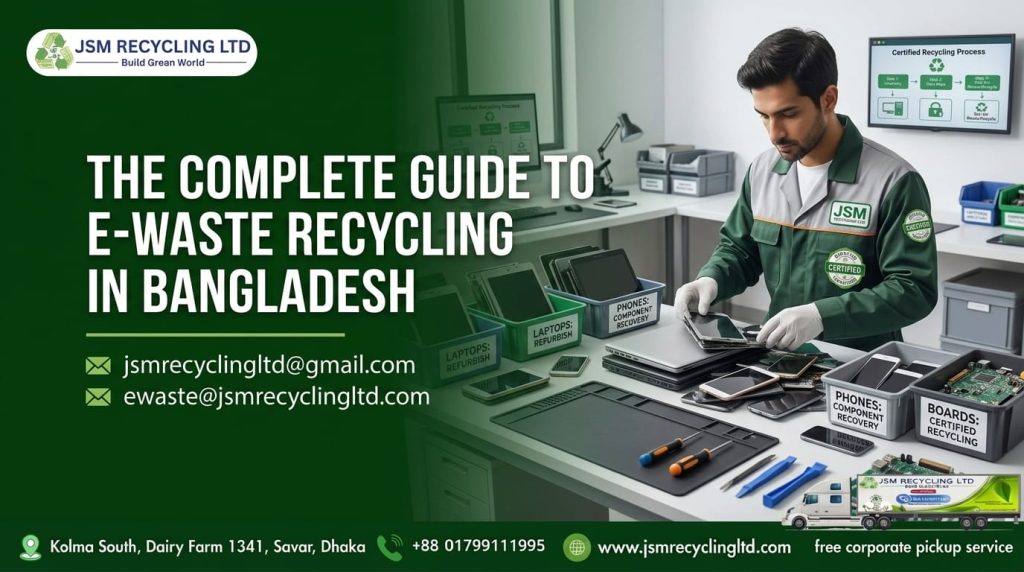
E-waste recycling in Bangladesh means safely collecting, dismantling, and processing old electronics so toxic materials never reach landfills, rivers, or informal scrap yards. Businesses need a clear corporate e-waste management strategy — inventory your devices, wipe data securely, and hand everything to a government-authorized recycler. JSM Recycling Ltd is Bangladesh’s 100% landfill-free, data-destruction-certified partner for exactly this job.
Every year, Bangladesh throws away hundreds of thousands of tons of old electronics — and most of it never gets recycled the right way. Whether you’re a homeowner clearing out a drawer of dead phones or an office manager building a corporate e-waste management strategy, this guide walks you through everything you need to know: what e-waste is, why it’s dangerous, how big the problem really is here, and the safest way to recycle it in Bangladesh.
What Is E-Waste Recycling?
E-waste recycling is the process of collecting old or broken electronic devices — laptops, phones, monitors, batteries, and more — and safely separating their parts so metals and plastics get reused while hazardous materials are disposed of properly, instead of being dumped, burned, or thrown into rivers and landfills.
A Simple Definition
Think of e-waste recycling as a controlled “take-apart” process. Skilled technicians open each device, remove batteries and circuit boards, wipe any stored data, and sort the remaining materials so they can be safely recovered or destroyed — never buried or burned in the open.
Common Examples of E-Waste
- Laptops, desktops, and computer monitors
- Mobile phones, tablets, and chargers
- Printers, scanners, and office electronics
- Servers, routers, and networking equipment
- Batteries — from remote controls to UPS backups
- Televisions and other household electronics
What Are the Main Types of E-Waste?
E-waste is generally grouped into a few clear categories, and knowing which one your item falls under helps you understand how it should be handled.
- IT & Telecom Equipment — computers, servers, phones, and networking gear, which often contain sensitive business data.
- Large Appliances — refrigerators, air conditioners, and washing machines, which contain refrigerant gases and heavy metals.
- Small Appliances — kettles, irons, and small electronics with simpler components but still hazardous plastics.
- Batteries & Hazardous Components — lithium, lead-acid, and nickel-cadmium batteries that leak toxic chemicals if crushed or burned.
Why Does E-Waste Recycling Matter?
Improper e-waste disposal isn’t just an environmental issue — it’s a direct risk to human health, business security, and legal compliance. Here’s why it deserves real attention.
Health Impact
When e-waste is burned or broken apart by hand — a common practice at informal scrap yards — it releases lead, cadmium, and mercury into the air, soil, and water. Workers and nearby residents absorb these toxins through skin contact, breathing, and contaminated food and vegetables grown near dumping sites.
Environmental & Business Impact
Unrecycled e-waste piles up in landfills and rivers, where it leaches heavy metals into soil and waterways for decades. For businesses, poor e-waste practices also damage brand reputation and can breach sustainability commitments made to clients, investors, or regulators.
Hidden Danger — Data Security
Most Bangladeshi businesses don’t realize that a “deleted” file is not a destroyed file. Standard formatting leaves data recoverable with free software. Old company laptops, servers, and phones sold to scrap dealers without certified data destruction can leak client records, financial data, and passwords — a risk far more serious than most companies assume.
How Big Is Bangladesh's E-Waste Problem?
Bangladesh generated close to 367,000 metric tons of e-waste in 2024 — about 2.2 kg per person — according to a 2025 study in the journal Environmental Challenges (Islam et al., 2025). Dhaka alone produces an estimated 475 tons of e-waste every single day, yet only 15% of it is recycled through proper channels, according to research published in Environmental Science and Pollution Research (2025).
What’s Happening Right Now in Bangladesh
The country’s e-waste stream is growing fast, driven by rapid smartphone turnover, the “Digital Bangladesh” push, and rising middle-class electronics ownership. Studies show national waste-collection efficiency ranges from just 37% to 77%, averaging around 55% — meaning nearly half of all waste, e-waste included, never reaches a proper facility at all.
Why Informal Recycling Methods Are Failing
An estimated 80%+ of Bangladesh’s e-waste is still handled by the informal sector — small scrap shops that dismantle devices by hand, burn cables to recover copper, and dump the rest in open land or waterways. National studies cited in peer-reviewed research suggest as little as 3% of e-waste is recycled through properly certified, formal channels, leaving the rest to pollute soil that has already tested well above WHO-safe lead limits in some Dhaka sites.
How to Build a Corporate E-Waste Management Strategy
For any Bangladeshi business — from a small clinic to a large corporate office — a proper corporate e-waste management strategy protects your data, your compliance record, and your sustainability goals. Here’s how to build one, step by step.
Best Practices for Businesses
- Take inventory of every electronic asset — laptops, phones, servers, printers, and cables — before deciding what to retire.
- Set a fixed replacement and disposal schedule instead of letting old devices pile up in storage.
- Assign one person or team to own e-waste decisions, so nothing gets quietly thrown in the regular trash.
- Choose a government-authorized recycler and get everything documented with a pickup and destruction record.
What to Do Before Recycling or Disposing of Devices
- Back up any files you need to keep, then remove SIM cards and memory cards.
- Request certified data destruction for every device that ever touched company or client data.
- Separate batteries from devices where possible, as they need special handling.
- Keep the pickup receipt and destruction certificate for your compliance records.
Why Choose a Government-Authorized Recycler
Only a Department of Environment (DoE) authorized recycler can legally guarantee safe processing and proper documentation. Working with an unlicensed scrap dealer — even one offering the best price — puts your business at legal, environmental, and data-security risk all at once.
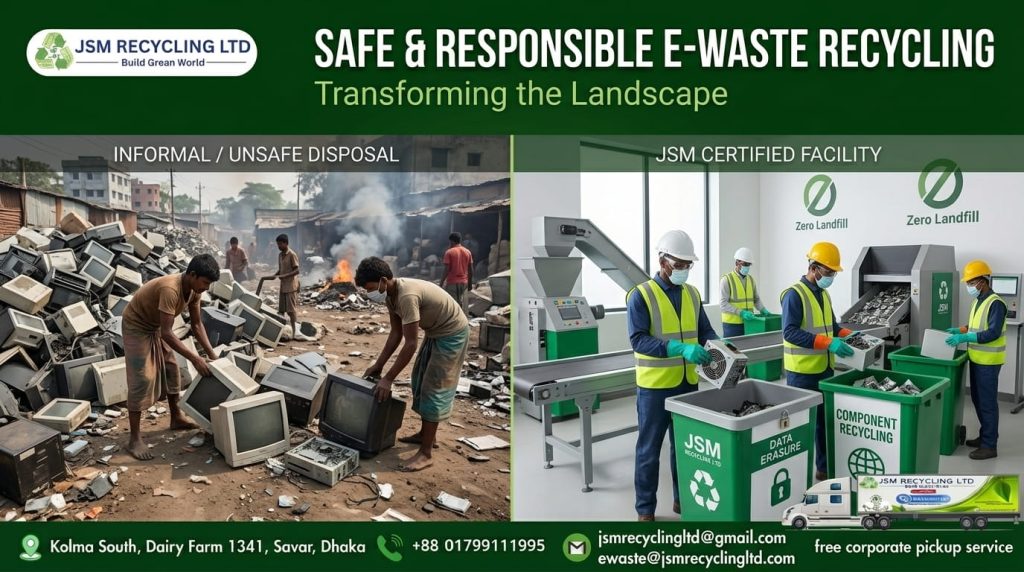
Safe vs. Unsafe E-Waste Disposal — At a Glance
Disposal Method | Safe & Recommended | Unsafe & Risky |
Data handling | Reformatting only, or no data wipe at all | |
Where it goes | Informal scrap dealer or roadside ‘bhangari’ shop | |
Environmental impact | Open burning, acid baths, dumping in landfills or rivers | |
Worker safety | Trained staff with protective equipment | Untrained labor with bare-hand dismantling |
Documentation | No paperwork, no accountability |
How JSM Recycling Ltd Is Solving Bangladesh's E-Waste Problem
JSM Recycling Ltd was built specifically to close the gap between Bangladesh’s growing e-waste problem and the country’s lack of trustworthy, formal recycling options.
Responsible Recycling
JSM Recycling operates a 100% landfill-free process. Every device that comes through the door is dismantled and processed responsibly — nothing is burned, buried, or dumped, unlike most informal scrap operations in the country.
Government Authorized & Data Destruction Certified
As a Department of Environment (DoE) authorized e-waste recycler, JSM Recycling provides verified data destruction certificates for every corporate device processed — giving businesses documented proof of compliance and data security, not just a promise.
Free Corporate Pickup & Community Drop-Off Events
With 8+ years of operations and 130+ community events held across Bangladesh, JSM Recycling makes responsible e-waste disposal accessible for both large corporate offices and everyday households, offering free corporate pickup alongside regular public drop-off drives.
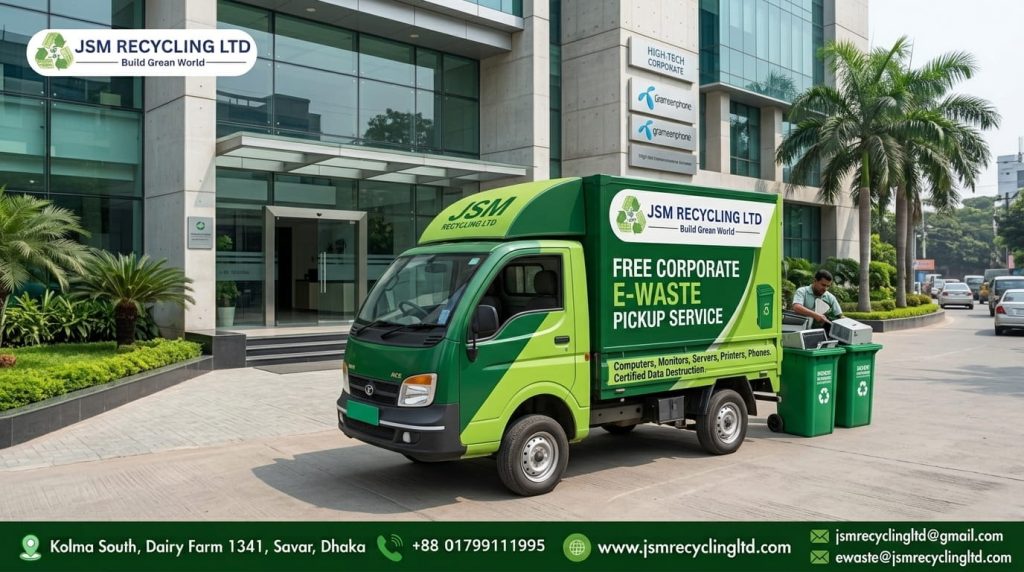
Choosing the Right Corporate E-Waste Management Strategy
E-waste recycling in Bangladesh is no longer optional — it’s a health, environmental, and business necessity. The safest path is simple: inventory your devices, insist on certified data destruction, and hand everything to a government-authorized recycler instead of the nearest scrap shop. A solid corporate e-waste management strategy built around these steps protects your business, your data, and your community.
Contact JSM Recycling Ltd today — Bangladesh’s only 100% landfill-free, government-authorized e-waste recycling company. Schedule your free corporate pickup or find your nearest community drop-off event at jsmrecyclingltd.com.
Frequently Asked Questions
E-waste recycling is the safe collection and processing of old electronic devices — like phones, laptops, and batteries — so their materials are recovered or destroyed properly instead of ending up in landfills, rivers, or open burning sites.
Is old electronic waste dangerous?
Yes. E-waste contains lead, mercury, and cadmium, which can contaminate soil, water, and air when burned or dumped, causing serious health problems for nearby workers, families, and children over time.
Is e-waste recycling mandatory in Bangladesh?
Bangladesh’s Department of Environment regulates hazardous and electronic waste handling, and businesses are expected to dispose of e-waste through authorized channels rather than informal scrap dealers to remain compliant.
How can I recycle e-waste in Bangladesh?
You can schedule a free corporate pickup or drop off devices at a community collection event through a government-authorized recycler like JSM Recycling Ltd, which serves businesses and households across the country.
Does JSM Recycling provide a certificate?
Yes. JSM Recycling issues a verified data destruction and recycling certificate for every device processed, giving businesses documented proof for compliance and internal records.