
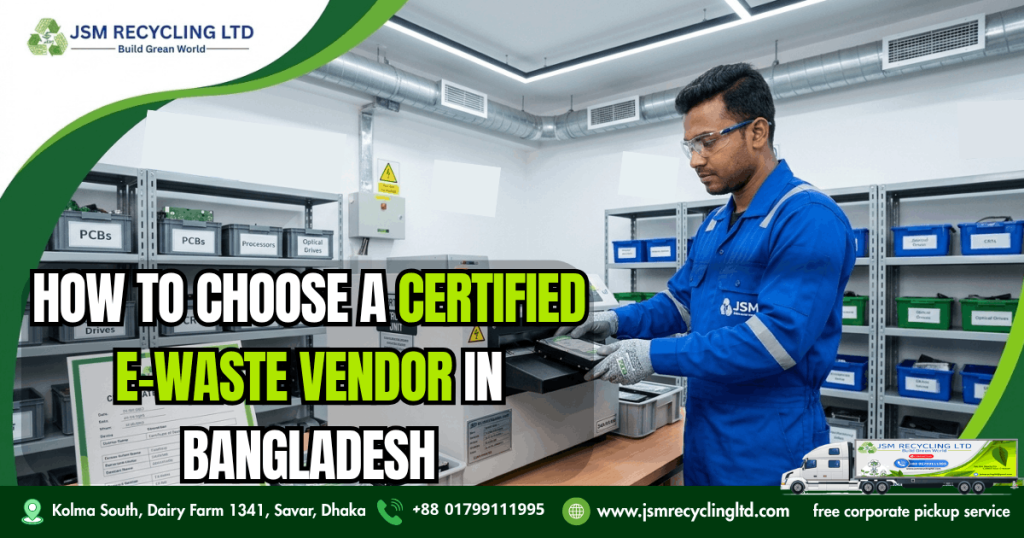
A certified e-waste vendor in Bangladesh isn’t just someone who collects your old electronics and disappears. A certified e-waste vendor is a government-authorized partner that protects your data, safeguards the environment, and follows strict legal standards. In Bangladesh, where informal e-waste handling costs lives and damages ecosystems, choosing the right partner changes everything.
This guide shows you exactly what makes a vendor certified, why it matters for your business, and how JSM Recycling—Bangladesh’s only 100% landfill-free, government-authorized e-waste company—sets the gold standard for responsible recycling.
What Is a Certified E-Waste Vendor? Understanding the Basics
A Simple Definition: Beyond Just Recycling
A certified e-waste vendor is a licensed company authorized by Bangladesh’s Department of Environment (DoE) to collect, dismantle, and recycle electronic waste safely and legally. Think of them as trained specialists who follow strict protocols—not informal dealers who sell your old phones on the black market or dump them in landfills.
The word “certified” is crucial. It means the vendor has proven they follow environmental protection rules, data security standards, and worker safety guidelines. Without certification, recyclers operate in legal gray zones that put both your business and the environment at risk.
Why E-Waste Is Different From Regular Trash
Electronic waste contains toxic materials that don’t belong in regular dumps. Circuit boards contain lead, mercury, and cadmium. Screens hold rare earth elements worth recovering. Your old devices also contain something more dangerous: your data.
When you give old equipment to an uncertified vendor, everything gets mixed together. Toxic materials leak into soil and groundwater. Your confidential business files, customer lists, and employee information disappear into informal channels where they’re sold or used for fraud. A certified e-waste vendor separates everything systematically—materials get recovered safely, and your data gets destroyed completely.
Types of Certified E-Waste Vendors: What You Need to Know
Type 1: Government-Authorized Recycling Companies
These vendors operate under direct DoE approval in Bangladesh. They maintain certified facilities, employ trained staff, and undergo regular government inspections. JSM Recycling falls into this category—one of only a few companies with full government authorization and verified landfill-free operations since 2016.
Type 2: Certified Data Destruction Specialists
Some vendors focus specifically on secure data destruction for businesses. They specialize in wiping drives, crushing hard drives, and issuing certificates proving data elimination. If your business handles sensitive information—which most do—this certification matters enormously.
Type 3: Corporate E-Waste Management Partners
Large companies contract with certified vendors to manage ongoing e-waste streams. These vendors provide regular pickups, inventory tracking, and detailed reporting. They’re built for businesses that generate significant electronic waste continuously.
Type 4: Community-Based Certified Recyclers
Some vendors combine certification with grassroots collection. They hold community events, educate the public, and recycle at scale. JSM Recycling operates 130+ community drop-off events across Bangladesh—making certified recycling accessible beyond corporate clients.
Why Choosing a Certified E-Waste Vendor Matters: The Real Risks
Health Impact: Toxic Exposure Affects Workers and Communities
When uncertified vendors handle e-waste, they expose workers and nearby communities to poisonous materials. Lead exposure causes permanent brain damage in children. Mercury contaminates drinking water sources. Arsenic builds up in soil, making it impossible to farm safely.
A 2024 study by the Global E-Waste Monitor estimated that improper e-waste handling in South Asia creates health costs exceeding $2 billion annually. In Bangladesh specifically, informal recycling operations concentrate in densely populated urban slums where families live directly alongside hazardous dismantling.
Certified vendors use protective equipment, follow containment protocols, and dispose of toxic materials through authorized channels. Your choice directly protects actual people’s health.
Environmental Damage: Soil, Water, and Air Contamination
Bangladesh’s rivers already struggle with pollution. Uncertified e-waste dumping accelerates this collapse. When heavy metals leach from old electronics, they concentrate in the food chain—fish absorb them, birds eat the fish, and these toxins end up on your dinner table.
Your computer’s circuit board contains more gold than some ore deposits. Certified vendors recover these valuable materials, reducing the need for new mining that destroys forests and consumes massive amounts of water. Uncertified dumpers extract nothing—they just create permanent damage.
The Hidden Danger: Data Security and Business Risk
Here’s what keeps security officers awake at night: old devices contain everything. Customer databases. Financial records. Employee information. Intellectual property.
When you hand equipment to an uncertified vendor, you have no guarantee what happens next. Hard drives get purchased by data recovery specialists who extract files and sell them. Some end up in cybercriminals’ hands. Your customer email list costs money on the dark web. Employee social security numbers enable identity theft.
Certified vendors provide data destruction certificates proving your information was permanently wiped—either through certified software deletion or physical destruction. In Bangladesh, regulatory frameworks now require businesses to prove secure disposal for compliance purposes. One breach from an uncertified vendor can cost you far more than proper recycling.
Bangladesh's E-Waste Crisis: Why This Matters Right Now
How Big Is Bangladesh's E-Waste Problem?
Bangladesh generates approximately 600,000 tons of e-waste annually—and that number grows 5% every year, according to 2024 data from the Bangladesh Bureau of Statistics. Yet certified recycling capacity exists for perhaps 15% of this volume.
The gap gets filled by informal handlers: small workshops, street traders, and unregulated dumps. An estimated 85% of Bangladesh’s e-waste ends up in uncontrolled environments, creating what researchers call an “environmental timebomb.
What's Happening Right Now in Bangladesh?
The DoE launched stricter regulations in 2023 requiring businesses to use certified vendors for e-waste disposal. Many companies scrambled to find compliant partners, discovering that certified options barely existed outside Dhaka. Enforcement remains inconsistent, but the legal direction is clear: informal e-waste handling carries increasing penalties.
Simultaneously, Bangladesh’s tech adoption accelerated sharply post-2020, meaning device replacement rates jumped. Older computers, phones, and networking equipment flood the market faster than formal recycling can handle. This creates both urgency and opportunity for responsible vendors.
Why Current Informal Methods Are Dangerous and Failing
Uncertified handlers cut corners on every level. They don’t pay for proper hazardous waste disposal, so they dump material in rivers, burn it in open pits, or sell it to even less regulated operations in neighboring regions. Their margins depend on avoiding environmental and safety costs.
This approach extracts short-term profit while creating long-term public health costs. Bangladesh’s Ministry of Environment documented arsenic contamination in groundwater directly traced to informal e-waste dumping in three districts. Respiratory diseases spike in neighborhoods near unregulated dismantling sites.
Certified vendors cost slightly more upfront—but they eliminate legal liability, environmental liability, and the reputational risk of being associated with harmful practices. For businesses serious about sustainability and compliance, informal recycling is simply no longer viable.
Best Practices: How to Safely Handle Your E-Waste in Bangladesh
Before You Call a Recycler: Prepare Your Devices
First, back up any important data you want to keep. Don’t assume your old device holds nothing valuable—sometimes forgotten files have legal importance.
Second, remove any removable components if your device has them: memory cards, batteries, external drives. Some vendors charge extra for mixed materials, and this helps them process materials more efficiently.
Third, document your equipment. Make a list of devices you’re recycling with serial numbers where possible. This becomes your accountability record and helps your vendor track materials through their system.
Fourth, request a pickup or delivery quote. Certified vendors typically provide free evaluations—they’re not afraid of transparency because they have nothing to hide.
What to Do Before Recycling: Data Security Checklist
Ask your vendor these specific questions:
- Do you offer certified data destruction?
- What certification do you hold for data security?
- Do you issue a Certificate of Destruction after the process?
- Can you document which devices received which destruction method?
- Do you guarantee no hard drives leave your facility intact?
Certified vendors answer these directly. They understand your liability concerns because they deal with businesses regularly. If a vendor seems vague or dismissive about data security, keep searching.
Why Government-Authorized Companies Are Non-Negotiable
A government-authorized vendor carries DoE registration, which means they’ve been inspected. They maintain facilities meeting environmental standards. They follow a chain of custody for hazardous materials. They’re insured, which protects you if something goes wrong.
Informal vendors carry zero accountability. If their dumping site causes pollution, there’s no one to sue. If they mishandle your data, you have no recourse. Government authorization isn’t a luxury—it’s your legal protection.
How JSM Recycling Ltd Is Solving Bangladesh's E-Waste Problem
Responsible Recycling That Actually Works
JSM Recycling operates Bangladesh’s only fully documented landfill-free e-waste system. Over 8+ years of operations, they’ve recycled electronics without sending a single ton to landfills. That’s not accidental—it’s systematic commitment.
They separate materials into precious metals, copper, aluminum, plastics, and glass. Each stream goes to appropriate recovery partners. Toxic components get stabilized and contained. Nothing gets dumped as a shortcut. This approach costs more than informal dumping, but JSM chose the right path over the cheap path.
Government Authorized & Data Destruction Certified
The Bangladesh Department of Environment authorizes JSM Recycling as a legitimate e-waste handler. They maintain ISO certifications for data destruction, meaning your sensitive information meets international security standards before physical destruction.
Clients receive detailed certificates of destruction showing exactly which devices received which security methods. This documentation protects your business during audits and compliance reviews. JSM understands that for corporate clients, proof matters as much as process.
Free Corporate Pickup & Community Drop-Off Events
JSM operates a dual model: corporate service and community access. Businesses can schedule free pickups directly through their corporate program, while individual Bangladeshi citizens can attend 130+ annual community events across the country to recycle safely at no cost.
This democratized approach means proper e-waste recycling isn’t locked behind corporate contracts. A student in Chittagong can bring old equipment to a JSM event without knowing anyone or paying fees. A family in Sylhet can ensure their broken devices don’t end up poisoning their environment. This scale of community engagement sets JSM apart.
The Clear Choice: How to Start Recycling Responsibly Today
E-waste recycling in Bangladesh has become simple—when you work with the right vendor. Stop asking friends where they take old electronics. Stop assuming your IT team will handle disposal safely. Stop hoping informal vendors will do the right thing.
Certified e-waste vendors exist specifically to solve this problem. They protect your data, they protect workers’ health, they protect Bangladesh’s environment, and they protect your business legally. The small additional cost compared to informal dumping becomes insignificant compared to the liability you eliminate.
Contact JSM Recycling Ltd today—Bangladesh’s only 100% landfill-free, government-authorized e-waste recycling company. Schedule your free corporate pickup or find your nearest community drop-off event at jsmrecyclingltd.com. Your business, your data, and your country will benefit.
Frequently Asked Questions About Certified E-Waste Vendors in Bangladesh
Q1: What’s the difference between “certified” and “uncertified” e-waste vendors?
A: Certified vendors hold government authorization, follow environmental protection standards, and provide documentation. Uncertified vendors operate informally with no oversight, no safety protocols, and no accountability. Certification proves the vendor has been inspected and approved by Bangladesh’s Department of Environment.
Q2: What health risks come from improper e-waste handling?
A: Uncertified e-waste handling exposes workers and nearby communities to lead, mercury, arsenic, and cadmium. These toxins cause developmental delays in children, kidney damage, neurological problems, and respiratory diseases. Studies show informal e-waste operations create health costs exceeding $2 billion annually across South Asia.
Q3: Is using a certified e-waste vendor legally required in Bangladesh?
A: Yes. Bangladesh’s Department of Environment regulations now require proper disposal of electronic waste. Businesses disposing through uncertified channels face penalties. Documentation from certified vendors proves compliance during regulatory audits, protecting your company from enforcement action.
Q4: How do I recycle old electronics safely in Bangladesh if I’m not a business?
A: JSM Recycling holds 130+ community drop-off events across Bangladesh where individual citizens can bring old electronics for free, responsible recycling. Visit jsmrecyclingltd.com to find events near you. This makes certified recycling accessible regardless of business size or location.
Q5: Does JSM Recycling provide a certificate proving data destruction?
A: Yes. JSM issues Certificate of Destruction documentation proving all data was permanently wiped from your devices. They provide detailed reports showing which devices received which destruction methods, giving you the documentation needed for compliance and security audits.
Q6: What happens to materials after JSM Recycling receives them?
A: JSM separates all materials into precious metals, copper, aluminum, plastics, and glass. Each stream goes to authorized recovery partners. Toxic components get stabilized and contained through certified processes. Nothing enters landfills—all materials get recovered or properly stabilized.
Q7: How much does certified e-waste recycling cost in Bangladesh?
A: JSM Recycling offers free corporate pickups for businesses through their partnership program. Community drop-off events are completely free. Pricing for large-scale operations or specific services varies based on equipment volume and destruction requirements—contact JSM directly for quotes.
Q8: Can an informal vendor destroy my data securely?
A: No. Informal vendors lack the equipment, training, and accountability for secure data destruction. Hard drives frequently leave informal facilities intact, where data recovery specialists can extract sensitive information. Only certified vendors with data destruction certificates guarantee complete security.