
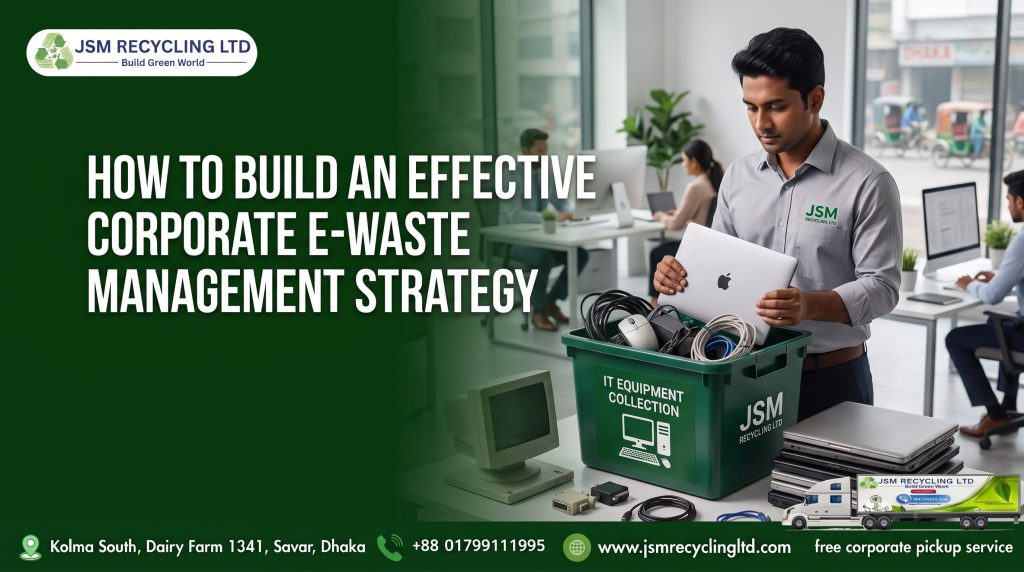
A corporate e-waste management strategy is a systematic framework businesses use to track, handle, and responsibly dispose of decommissioned IT assets. To build one, you must implement a formal internal policy, conduct regular IT audits, partner with a government-authorized recycler like JSM Recycling Ltd, and obtain verified data destruction certificates to ensure compliance.
How to Build an Effective Corporate E-Waste Management Strategy
Implementing a robust corporate e-waste management strategy is no longer just an environmental choice; it is a critical business necessity for modern organizations in Bangladesh. As digital transformation accelerates across Dhaka and beyond, businesses are accumulating vast amounts of electronic waste, including servers, laptops, and mobile devices. A professional e-waste disposal strategy ensures that your firm complies with environmental regulations, minimizes liability, and protects sensitive corporate data from security breaches.
Certified data destruction is the process of permanently erasing or physically destroying information stored on electronic devices to ensure it cannot be recovered. By partnering with authorized recyclers, businesses ensure that retired assets are handled in a way that protects both the environment and their proprietary digital information.
What is the goal of a corporate e-waste strategy?
The primary goal of a corporate e-waste strategy is to transition from unmanaged disposal to a circular model that prioritizes data security and environmental sustainability. It establishes a clear chain of custody for all hardware, preventing hazardous materials from leaching into local ecosystems while ensuring that no company data leaves your premises on unformatted hard drives.
Why businesses need a standardized approach
Without a standardized policy, IT departments often store retired electronics in storage rooms, creating fire hazards and “data graveyards.” An effective strategy simplifies compliance reporting, reduces insurance premiums, and demonstrates Corporate Social Responsibility (CSR) to stakeholders and international partners who prioritize green supply chains.
What Are the Key Types of Corporate E-Waste?
Understanding what qualifies as e-waste is the first step toward effective management. You can categorize your office electronics into four primary streams, each requiring specific handling protocols:
- Computing Hardware: This includes desktops, laptops, tablets, and thin clients. These items are the most sensitive because they contain hard drives and SSDs housing internal company data, customer databases, and proprietary software.
- Networking & Server Infrastructure: Racks, switches, routers, and server blades. These assets often contain higher concentrations of precious metals and require specialized de-manufacturing processes to recover valuable components like gold, copper, and rare-earth magnets.
- Peripheral & Input Devices: Monitors, printers, scanners, mice, and keyboards. While these contain less sensitive data, they are rich in heavy metals like lead, mercury, and cadmium, which require specialized chemical treatment to prevent soil contamination.
- Mobile & Communication Devices: Smartphones, desk phones, and tablets. These contain lithium-ion batteries, which pose a significant fire risk if improperly stored or damaged during the disposal process.
Why Is E-Waste Management Critical for Businesses?
Health and human impact
When electronic waste is disposed of in landfills or handled by the informal sector in Bangladesh, toxic chemicals are released into the local environment. Lead, mercury, and cadmium seep into the groundwater, while the burning of plastic casings releases carcinogenic fumes, causing severe respiratory and neurological issues for local waste workers.
Environmental and business impact
Beyond local health, poor e-waste practices carry heavy reputational risks. Global investors and clients increasingly demand proof of sustainable waste management. If your company is linked to illegal dumping or environmental degradation, it can lead to legal penalties, loss of government licenses, and significant damage to your brand’s value.
The hidden danger: Data security
The most significant, yet often overlooked, risk is data theft. Simply “deleting” files or formatting a drive is not enough. Sophisticated recovery software can retrieve sensitive financial records, passwords, and client lists from discarded hardware. This makes secure data destruction a mandatory pillar of any business e-waste recycling program.
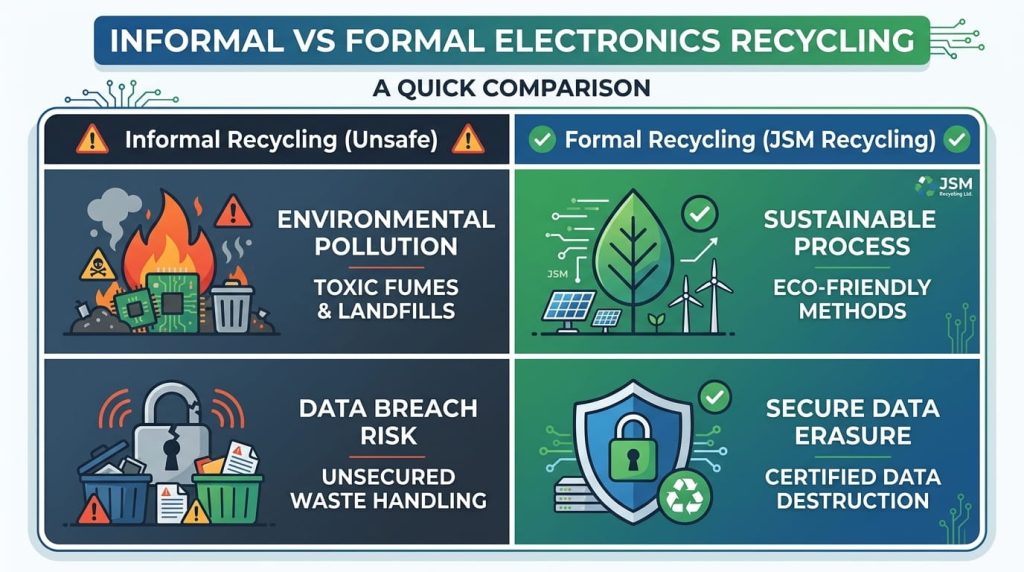
Feature | Informal Disposal | Certified Professional Recycling |
Data Security | High Risk (Data Recovery Possible) | Guaranteed (Certified Destruction) |
Environmental Impact | Severe (Toxic Leaching) | Zero (Landfill-Free) |
Legal Compliance | None | Fully Compliant |
Asset Recovery | None | Possible Value Recovery |
The Reality of E-Waste in Bangladesh
How big is the problem in Bangladesh?
The challenge is growing exponentially. According to the Global E-Waste Monitor 2025, Bangladesh generates over 400,000 metric tons of electronic waste annually. Dhaka alone accounts for nearly 43% of this total, with the volume of discarded IT equipment rising by 15% year-on-year as offices upgrade their infrastructure.
What is happening right now in Bangladesh?
Currently, the vast majority of e-waste in the country is handled by the informal sector. These operators use “backyard” methods like acid baths and open-air burning to recover copper and gold. While they provide a service, these methods are highly dangerous and contribute to the rapidly increasing levels of toxic waste in urban soil and water supplies.
Why informal methods are failing
Informal recycling is unsustainable because it fails to capture hazardous components safely. Furthermore, it offers no protection for corporate data. As Bangladesh tightens its environmental regulations, businesses can no longer rely on unverified scrap dealers. You need a transparent audit trail to prove that your equipment has been processed according to legal standards.
Best Practices: How to Implement Your Strategy
To build an effective business e-waste recycling process, follow these structured steps:
- Conduct an IT Audit: Create an inventory of all end-of-life (EOL) assets. Identify which devices still have value and which are ready for recycling.
- Implement Data Sanitization: Ensure all storage media is wiped using industry-standard protocols (like NIST 800-88) or physically shredded.
- Select a Government-Authorized Partner: Vet your recycling company. Ensure they hold valid Department of Environment (DoE) permits and are capable of providing a certificate of destruction.
- Establish Secure Storage: Until the equipment is picked up, store it in a locked, dry area to prevent theft and unauthorized access.
- Obtain Documentation: Always demand a waste transfer note and a certificate of destruction for every batch of equipment sent for recycling.
How JSM Recycling Ltd is Solving Bangladesh’s E-Waste Problem
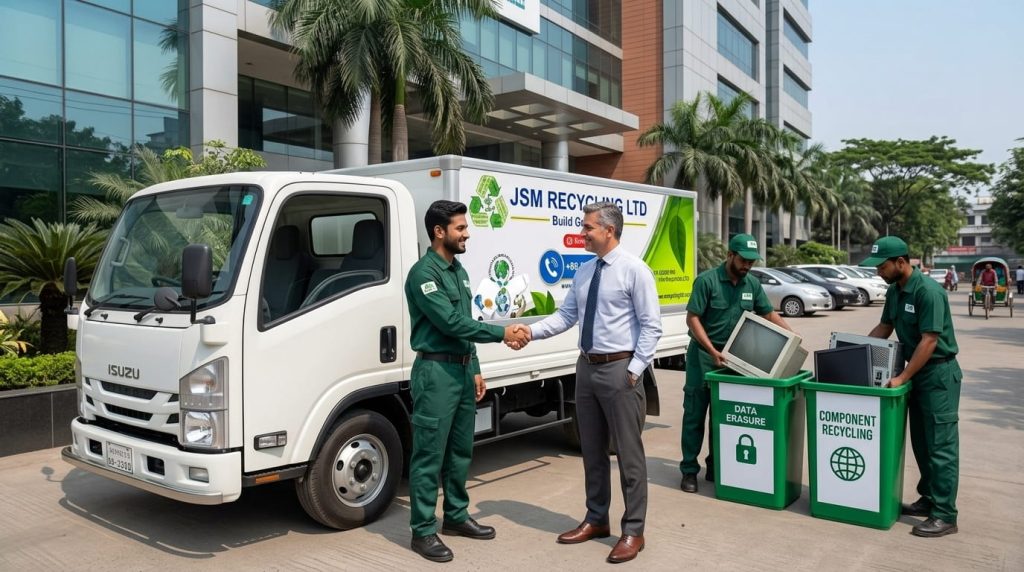
JSM Recycling Ltd is the leader in sustainable IT asset disposal in Bangladesh. We have spent over 8 years perfecting a 100% landfill-free process.
Responsible Recycling
We ensure that every component—from circuit boards to plastics—is recycled or repurposed responsibly. Our closed-loop system ensures that hazardous materials are neutralized, while valuable metals are recovered and returned to the manufacturing supply chain, reducing the need for raw mining.
Government Authorized & Data Destruction Certified
JSM Recycling is a government-authorized e-waste recycling company in Bangladesh. We provide our corporate clients with verifiable, audited data destruction certificates, ensuring that your company meets all legal requirements and internal security standards regarding privacy and information disposal.
Free Corporate Pickup & Community Drop-Off Events
We believe in community-wide change. Beyond our services for large corporations, we have successfully organized 130+ community events across Bangladesh to educate the public. For businesses, we offer free, scheduled corporate pickups, making it as simple as possible for you to maintain a clean, secure, and sustainable office environment.
A comprehensive corporate e-waste management strategy is essential for any modern business in Bangladesh. By taking control of your IT disposal process, you protect your company from data breaches, satisfy environmental regulations, and contribute to a healthier country. Remember, your old equipment is not just “trash”; it is a security risk and an environmental responsibility. Partnering with a professional, government-authorized entity like JSM Recycling Ltd ensures your organization remains secure, compliant, and sustainable.
Contact JSM Recycling Ltd today — Bangladesh’s only 100% landfill-free, government-authorized e-waste recycling company. Schedule your free corporate pickup or find your nearest community drop-off event at jsmrecyclingltd.com.
Frequently Asked Questions
What is the definition of corporate e-waste management?
Corporate e-waste management is the strategic process of tracking, collecting, and disposing of obsolete electronic equipment in a way that is legally compliant, environmentally safe, and data-secure. It focuses on recovering materials and protecting the company from security and environmental liabilities.
What are the primary risks of improper e-waste disposal?
Improper disposal leads to two major risks: severe environmental damage from leaking toxic chemicals like lead and mercury, and a high risk of corporate data theft. If discarded hard drives are not properly destroyed, sensitive company information can easily be recovered by unauthorized parties.
Is it illegal to throw away office electronics in Bangladesh?
While regulations are evolving, companies are increasingly held liable for improper waste disposal under environmental protection acts. Using a government-authorized recycler like JSM Recycling Ltd ensures you remain within the law and provides the necessary documentation for your compliance audits.
How can my company start an e-waste recycling program?
Start by auditing your current IT inventory and identifying assets that are no longer in use. Once you have a list, contact a certified recycler like JSM Recycling Ltd to schedule a professional pickup and ensure you receive the proper data destruction documentation for your records.
Does JSM Recycling provide a certificate for data destruction?
Yes, JSM Recycling Ltd provides fully verifiable data destruction certificates to all corporate clients. This document serves as legal proof that your devices were handled securely and the information contained on them has been permanently rendered unrecoverable
One Response