
E Waste Management Bangladesh: A Complete Guide for Businesses
⭐ Quick Answer
E waste management Bangladesh means collecting your old electronics, wiping their data securely, and sending them to a government-authorized recycler. Do not sell them to scrap dealers or throw them away. Bangladesh’s Hazardous Waste (e-waste) Management Rules, 2021 regulate this waste. For a business, the safest path is a certified recycler who gives you a data destruction certificate.
E waste management Bangladesh is a bigger business risk than most owners realize. Your old laptop may look useless, but it can still hold client files, passwords, and bank details.
Corporate e-waste management is the process of collecting, securely wiping, and responsibly recycling a company’s unused electronics. This guide explains how to do it right, in plain English.
What Is Corporate E-Waste Management?
Corporate e-waste management is the planned way a business collects, tracks, and recycles old electronics. It includes wiping data, choosing a legal recycler, and keeping proof of disposal. It protects your data, your staff, and the environment.
A Simple Definition
E-waste means any electronic item that is broken, outdated, or no longer needed. When a company handles it through a clear plan, that is corporate e-waste management. It is also called IT asset disposal when it covers computers and servers.
Common Examples of Office E-Waste
Most offices hold more e-waste than they think. Look in storage rooms, server closets, and the bottom of drawers.
- Old desktops, laptops, and monitors
- Printers, copiers, and scanners
- Routers, switches, and UPS batteries
- Mobile phones and tablets
Now that you know what counts, let’s look at the main types.
What Are the Main Types of Business E-Waste?
Business e-waste falls into four main groups. Each group needs slightly different handling because of the materials and data inside. Knowing the group helps you plan safe electronic waste recycling.
- Computing equipment: desktops, laptops, servers, and hard drives. These carry the highest data risk.
- Office electronics: printers, copiers, projectors, and phones. Many store scanned documents in their memory. This is the core of office electronics recycling.
- Power and network equipment: UPS units, batteries, routers, and cables. Batteries can leak or catch fire.
- Small devices and storage media: mobile phones, tablets, USB drives, and backup tapes. They are easy to lose and easy to forget.
Next, let’s see why getting this right matters so much.
Why Does Proper E-Waste Disposal Matter for Your Business?
Proper disposal matters because e-waste harms health, pollutes land and water, and can leak your private data. A safe e-waste disposal strategy protects your people, your reputation, and your legal standing. Ignoring it can cost far more than doing it correctly.
The Health and Human Impact
Electronics contain lead, mercury, and cadmium. These are toxic metals. When scrap workers burn or smash devices, the fumes and dust enter their lungs and skin.
Women are often involved in collecting and sorting e-waste in Bangladesh, and they face the same exposure — Transparency International Bangladesh (TIB), 2025.
The Environmental and Business Impact
Toxic metals from dumped electronics can seep into soil and water. From there, they can reach crops and drinking water.
For your business, this is also a reputation issue. Clients and investors now ask about sustainable waste management. Good corporate sustainability includes what you do with old equipment.
The Hidden Danger: Your Data
Deleting files does not remove them. Data can often be recovered from a “cleaned” hard drive with free software.
Secure data destruction is the process of erasing or physically destroying storage so that data cannot be recovered by anyone. A certificate proves it was done. Without proof, one resold laptop could expose your clients’ information.
E Waste Management Bangladesh: How Big Is the Problem?
Bangladesh produces hundreds of millions of kilograms of e-waste each year, and almost all of it is handled informally. Only a tiny share reaches licensed recyclers. That gap is a risk for every business that discards electronics.
How Big Is the Problem in Bangladesh?
Estimates vary because the country has no central e-waste database. TIB notes that studies for 2021 range from 170 million to 600 million kg.
The WEEE Society Bangladesh puts the figure at 367 million kg a year, or 2.2 kg per person — WEEE Society Bangladesh, via Dhaka Tribune. That is much lower than the global average of 7.8 kg per person — Global E-waste Monitor 2024. Your electronics use is rising fast, so this number will grow.
What Is Happening Right Now in Bangladesh?
The Hazardous Waste (e-waste) Management Rules, 2021 have been in force since June 2021. They ask producers to reach a collection target of 10% in year one, rising to 50% by year five — TIB, 2025.
Real progress is slow. About 97% of e-waste goes through informal channels, and only 3% reaches formal recyclers — TIB, 2025. Also, 88% of consumers do not know how to dispose of e-waste properly — TIB, 2025.
About 30 million mobile phones become e-waste every year — Bangladesh Mobile Phone Importers’ Association (BMPIA), via Dhaka Tribune. Worldwide, only 22.3% of e-waste was formally collected and recycled in 2022 — Global E-waste Monitor 2024.
Why Informal Methods Are Dangerous or Failing
Many businesses sell old equipment to local scrap dealers because it is easy and pays a little cash. But informal handling has real costs.
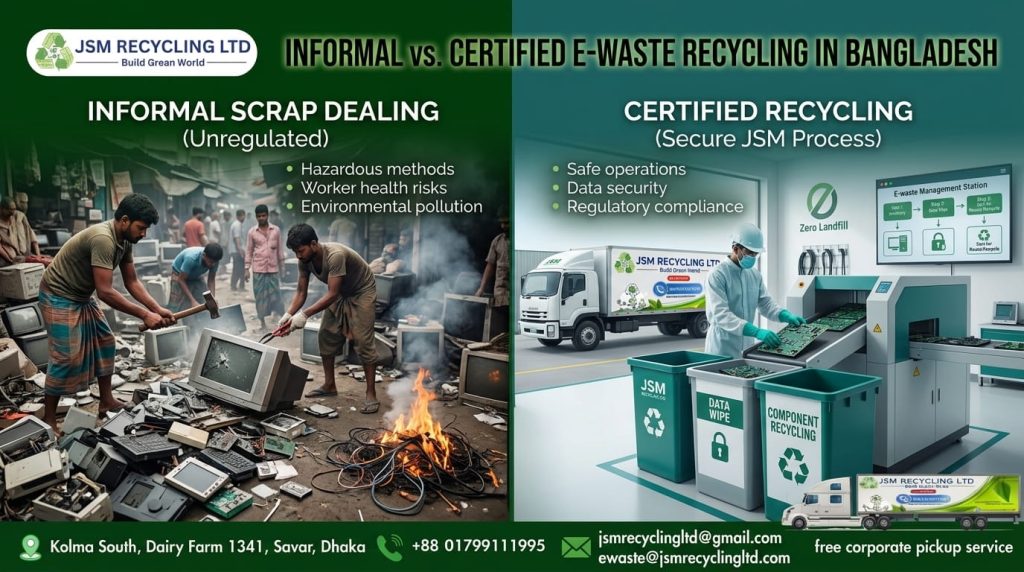
Factor | Informal Scrap Dealer | |
Data safety | Devices often resold with data intact | Secure data destruction with a certificate |
Worker safety | Burning, acid, no protection | Trained staff, safe processes |
Legal standing | Often unregistered | Government-authorized (DoE) |
Environmental impact | Dumping and open burning | Landfill-free processing |
Proof of disposal | None | Written records and certificates |
Even among registered players, checking matters. About half of the 14 institutions registered with BTRC reportedly operate without DoE registration — TIB, 2025.
So what should a careful business do instead? Let’s walk through it.
E Waste Management Bangladesh: How Can Your Business Recycle Safely?
The safest method is to inventory your devices, protect your data, and hand everything to a certified recycler. Then keep the paperwork. This turns business e-waste recycling from a headache into a simple, repeatable routine.
Safe Methods and Best Practices
Follow these steps for any old equipment:
- List everything. Count devices by type, and note which ones store data.
- Separate the items. Keep data-bearing devices apart from cables, batteries, and other items.
- Back up what you need. Move important files to a safe place first.
- Do not rely on deleting. Request secure data destruction instead of a simple format.
- Check your recycler. Ask for proof of Department of Environment (DoE) authorization.
- Schedule a pickup. Do not let staff carry devices out informally.
- Collect your certificates. Keep the data destruction certificate and disposal record on file.
What to Do Before Recycling or Disposing
Before pickup, remove SIM cards and memory cards. Log out of company accounts on phones and laptops. Take off asset tags only after you record them.
Also tell your IT team. They know which drives held sensitive files and can flag them for extra care.
Why Choose a Government-Authorized Company?
An authorized company follows the law, so you do too. You also get documents you can show auditors, clients, or regulators.
- Legal peace of mind under the 2021 Rules
- A paper trail for your ESG or sustainability report
- Lower risk of a data leak from resold devices
- Proof that nothing went to a landfill
Certified e-waste recycling is not just a “nice to have.” It is your best protection.
How JSM Recycling Ltd Is Solving Bangladesh's E-Waste Problem
JSM Recycling Ltd works to close the gap between the 97% and the 3%. It is a government-authorized recycling company with over eight years of experience. Its approach is simple: do it legally, do it safely, and prove it.
Responsible Recycling
JSM Recycling Ltd has run 100% landfill-free operations for more than eight years. Nothing it collects is dumped in a landfill. Materials are processed so that useful parts return to use.
Government Authorized and Data Destruction Certified
JSM Recycling Ltd holds government authorization from the Department of Environment (DoE) Bangladesh. It is also data destruction certified.
Every business client can receive a verified data destruction certificate. That certificate is your proof that private data was destroyed properly.
Free Corporate Pickup and Community Drop-Off Events
Companies can book a free corporate pickup. This suits offices, banks, hospitals, and factories with large volumes.
For households and small teams, JSM Recycling Ltd has held more than 130 community events across Bangladesh. These events make drop-off easy and teach people why safe disposal matters.
Start Your E Waste Management Bangladesh Plan Today
Good e-waste management Bangladesh starts with one decision: stop treating old electronics as trash. Wipe the data properly, use a certified and government-authorized recycler, and keep the proof. Do that, and you protect your clients, your staff, and your name.
Also remember that the rules are new and enforcement is still developing. Businesses that act early will be ready as the rules tighten.
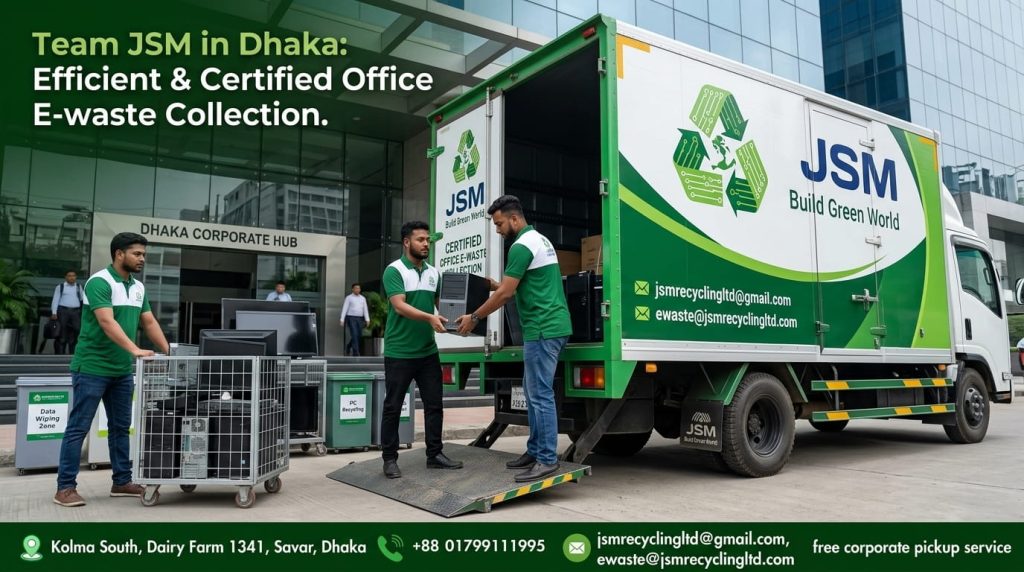
Contact JSM Recycling Ltd today — Bangladesh’s only 100% landfill-free, government-authorized e-waste recycling company. Schedule your free corporate pickup or find your nearest community drop-off event at jsmrecyclingltd.com
Frequently Asked Questions (FAQ)
Q: What is e-waste management?
E-waste management is the process of collecting, sorting, and recycling old electronics safely. It includes wiping data and recycling parts so toxic materials do not harm people or the environment. Businesses often call this IT asset disposal.
Q: Why is throwing away old computers dangerous?
Old computers contain toxic metals like lead and mercury, and they can still hold private data. Dumped devices pollute soil and water, and a discarded hard drive can expose passwords, client records, and financial files.
Q: Is e-waste recycling required by law in Bangladesh?
Bangladesh regulates e-waste through the Hazardous Waste (e-waste) Management Rules, 2021, issued under the Bangladesh Environment Conservation Act, 1995. The rules cover the handling, storage, transport, and recycling of e-waste. Businesses should give e-waste only to registered recyclers and confirm requirements with the Department of Environment.
Q: How can my company recycle old computers in Bangladesh?
List your devices, back up important files, and contact a government-authorized recycler for pickup. Ask for a data destruction certificate and keep it for your records. Do not sell devices to unregistered scrap dealers.
Q: Does JSM Recycling Ltd provide a data destruction certificate?
Yes. JSM Recycling Ltd is data destruction certified and provides verified data destruction certificates to its clients. It is also authorized by the Department of Environment (DoE) Bangladesh and operates 100% landfill-free.