
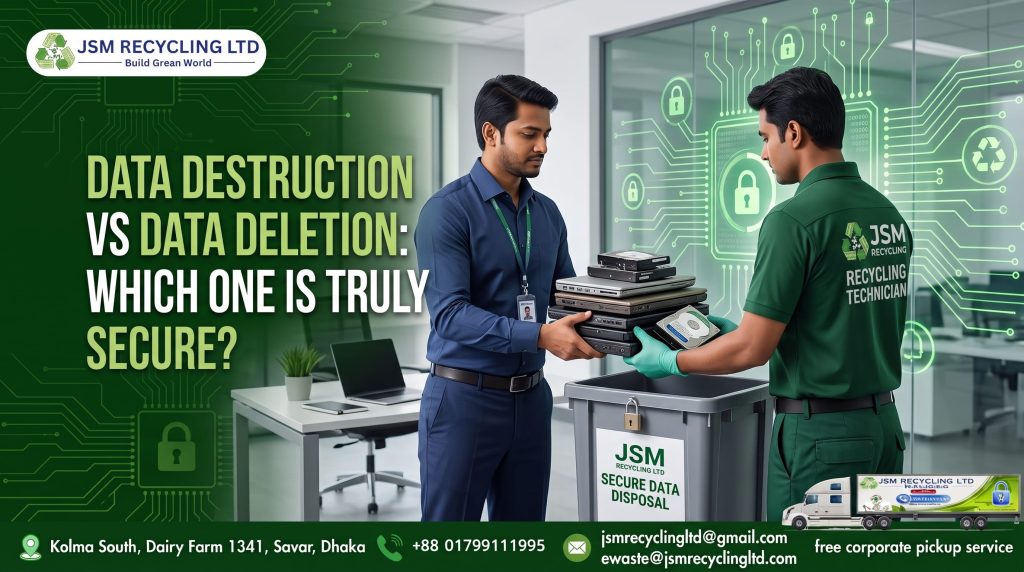
Data deletion only removes the “pointer” to a file, not the file itself — meaning deleted data can almost always be recovered using free forensic software. Data destruction physically or digitally destroys the storage medium so the data can never be rebuilt. For businesses in Bangladesh handling customer records, financial data, or medical files, only certified data destruction — like the service offered by JSM Recycling Ltd — meets the legal and security standard required for safe IT asset disposal.
If your office has ever thrown away an old laptop, hard drive, or office printer after “deleting everything,” this article is for you. Many corporate offices in Bangladesh believe pressing delete or formatting a drive makes their data disappear. It doesn’t. This is one of the biggest misunderstandings in data destruction vs data deletion, and it’s putting businesses at serious risk.
In this guide, we’ll break down exactly why data deletion is not secure, what forensic recovery really means, and why certified data destruction is now a business necessity — not an option — in Bangladesh.
What Is the Difference Between Data Deletion and Data Destruction?
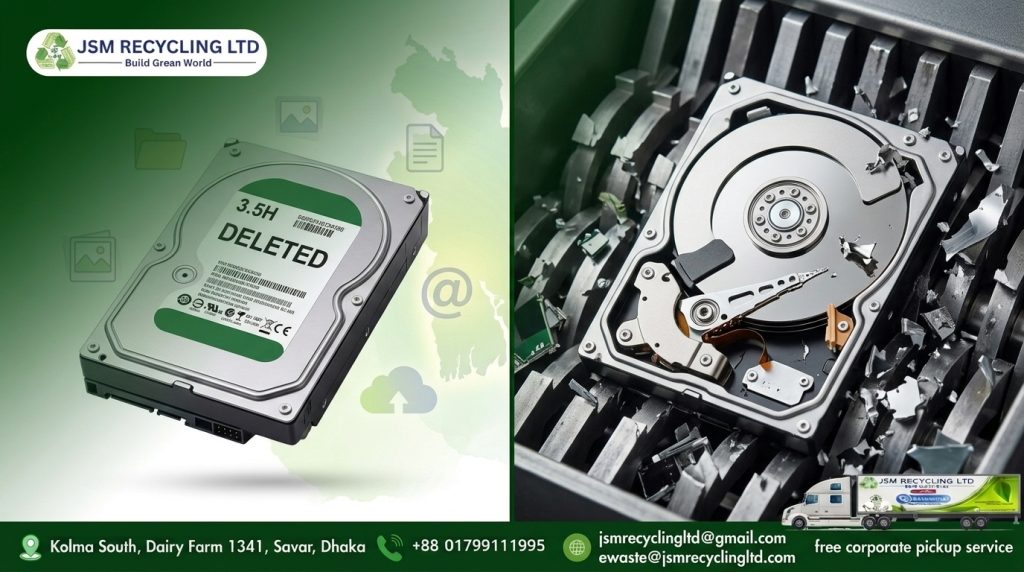
Data deletion removes a file’s address from your device’s index, but the actual data stays on the drive until it’s overwritten — which can take months or years. Data destruction, on the other hand, physically shreds the drive or uses certified software to overwrite every sector multiple times, making recovery technically impossible. One hides data; the other eliminates it.
Think of your hard drive like a library. Deleting a file is like removing a book’s card from the catalog — the book is still sitting on the shelf, waiting for anyone who knows where to look. Data destruction is like shredding the book itself, page by page, so there’s nothing left to find.
This distinction matters more than most business owners realize, especially when old computers, servers, or phones leave the office for good.
Why Is Data Deletion Not Secure Enough for Businesses?
Data deletion is not secure because the underlying data remains physically stored on the drive’s platters or memory chips. Anyone with basic forensic recovery software — much of it free and downloadable in minutes — can retrieve “deleted” files, including customer databases, financial records, and confidential contracts, from a device that looks completely empty.
Even a full format doesn’t guarantee safety. Formatting rewrites the file system structure, not the data itself. Unless your business specifically uses a certified wiping standard or physical destruction, that “empty” hard drive is really a locked box with the key still under the mat.
For corporate offices handling client information — banks, hospitals, law firms, telecom companies, NGOs — this gap between deleted and destroyed can mean the difference between compliance and a serious data breach.
The Hidden Danger: Forensic Data Recovery From Discarded Drives
This is the part most Bangladeshi businesses overlook. When old laptops, servers, and hard drives leave your office — through informal scrap dealers, auctions, or unmanaged donations — they often end up resold in secondhand electronics markets. From there, anyone can plug the drive into a recovery tool and pull out everything that was supposedly deleted.
This isn’t a rare, worst-case scenario. It’s a documented, ongoing risk:
- Recovered data can include employee salary records, customer NID numbers, medical histories, banking details, and internal business strategy documents.
- Recovery tools are cheap, widely available, and require no technical expertise to use.
- A single recovered drive can expose thousands of customer records at once.
In short, an old hard drive thrown in a storeroom or sold to a scrap dealer is not “waste.” It’s an unlocked filing cabinet full of your company’s — and your customers’ — most sensitive information.
Why Informal Recycling Is a Data Security Threat in Bangladesh
Bangladesh generated roughly 367 million kilograms of e-waste in 2022, at a rate of 2.2 kg per person, according to the Global E-Waste Monitor 2024, published by the UN’s ITU agency. That number is growing by nearly 20–30% every year as offices upgrade computers, servers, and phones faster than ever.
Here’s the alarming part: a Transparency International Bangladesh (TIB) study found that 97% of the country’s e-waste is processed through informal channels, while only about 3% reaches certified, formal recycling facilities. That means the vast majority of discarded office electronics — including hard drives packed with business data — pass through untrained scrap dealers with no data-wiping process, no chain of custody, and no accountability at all.
Informal recyclers are focused on recovering copper, gold, and reusable parts. They have no obligation, training, or incentive to destroy the data sitting inside. This is exactly why data breaches linked to discarded IT equipment continue to rise across South Asia — and why “just give it to the scrap guy” is one of the riskiest decisions a business can make.
Safe vs. Unsafe Disposal Methods: A Quick Comparison
Disposal Method | Data Security Level | Environmental Impact | Legally Compliant? |
Throwing in regular trash | None — fully recoverable | Toxic landfill contamination | No |
Selling to informal scrap dealers | None — data often resold intact | Unregulated, hazardous | No |
Simple delete or format | Low — recoverable with free software | N/A | No |
Certified data wiping (software) | High — meets audit standards | Depends on final e-waste handling | Yes, if documented |
Certified physical destruction (JSM Recycling) | Highest — physically irrecoverable | 100% landfill-free processing | Yes, with certificate |
How Can Businesses Ensure Their Data Is Truly Destroyed?
Businesses should partner with a government-authorized e-waste recycler that provides certified data destruction with a documented chain of custody. This means every device is tracked from pickup to final destruction, and the business receives an official certificate confirming the data can never be recovered.
Here’s a simple, practical process every corporate office in Bangladesh can follow:
- Inventory your retiring devices — list every laptop, server, hard drive, and phone scheduled for disposal.
- Choose a government-authorized recycler — verify credentials before handing over a single device.
- Request certified data destruction, not just recycling — ask specifically for a data destruction certificate.
- Keep documentation on file — this protects your business during audits or in case of a future data breach investigation.
- Confirm landfill-free processing — ensure the physical e-waste itself is also handled responsibly, not dumped or burned.
Why JSM Recycling Ltd Is Bangladesh's Trusted Choice for Secure IT Asset Disposal
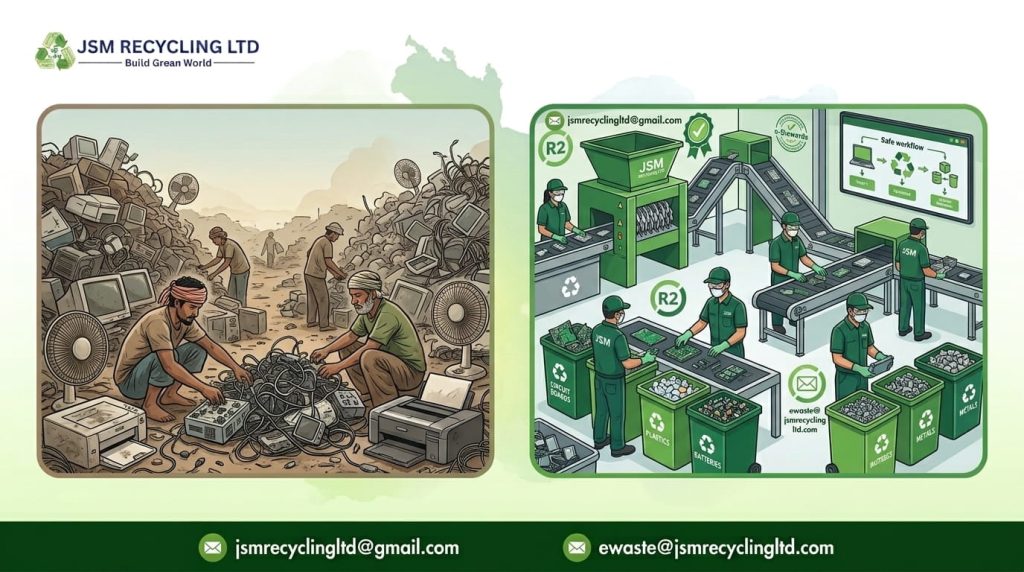
This is exactly the gap JSM Recycling Ltd was built to close. As a government-authorized e-waste recycling company with 8+ years of experience in Bangladesh, JSM Recycling Ltd offers certified secure data destruction alongside responsible, 100% landfill-free electronic waste recycling.
Unlike informal scrap dealers, JSM Recycling Ltd follows a documented process for every device — from pickup to final, certified destruction — so your business e-waste recycling never becomes a security liability. The company has also hosted 130+ community events across Bangladesh, raising public awareness about the real risks of informal e-waste handling and the importance of secure IT asset disposal for both businesses and households.
For any organization serious about secure data destruction, choosing a certified partner isn’t just good practice — in an environment where 97% of e-waste bypasses formal handling entirely, it’s often the only thing standing between your business and a costly, preventable data breach.
Don't Confuse Deletion With Destruction
The debate over data destruction vs data deletion isn’t just technical — it’s a real business risk. Deleting a file gives your business a false sense of security while the data itself often remains fully recoverable. True protection only comes from certified, verifiable data destruction carried out by a licensed electronic waste recycling partner.
Contact JSM Recycling Ltd today — Bangladesh’s only 100% landfill-free, government-authorized e-waste recycling company. Schedule your free corporate pickup or find your nearest community drop-off event at jsmrecyclingltd.com.
Frequently Asked Questions
What is the difference between data deletion and data destruction?
Data deletion removes a file’s reference from the system while the actual data stays on the drive and can be recovered. Data destruction permanently eliminates the data through physical shredding or certified overwriting, making recovery impossible.
Why do businesses need certified data destruction instead of just deleting files?
Deleted files can be recovered using widely available forensic software, exposing sensitive business and customer data. Certified data destruction removes this risk completely and provides documented proof for compliance and audit purposes.
How does JSM Recycling Ltd destroy data securely?
JSM Recycling Ltd follows a tracked chain-of-custody process, physically or digitally destroying storage devices so the data cannot be reconstructed, and provides certification confirming secure destruction.
Is data destruction legally required for businesses in Bangladesh?
While Bangladesh’s e-waste regulations focus mainly on environmental compliance, businesses handling customer data have a duty of care to prevent data breaches. Using a government-authorized recycler with certified data destruction is the safest way to meet that responsibility.
Does JSM Recycling Ltd provide a certificate after data destruction?
Yes. JSM Recycling Ltd issues a data destruction certificate for every device processed, giving businesses documented proof for internal records, client assurance, or regulatory audits.